Waterford retroblog
Last week I got my tickets to Shannon for Shelley's wedding in Westport (and general catch-up in Galway), plus Ryanair tickets from Knock to London to hang out with Seanan over New Years. This got me thinking about the little road trip he and I took two years ago, when we spent a couple nights in the guesthouse at Mount Melleray Abbey outside Cappoquin, County Waterford.I'd got the notion of a monastic retreat from H.V. Morton's In Search of Ireland, published in 1930. (At the time I was working on a story idea, and though that story's on the back burner now my experience there was still very worthwhile.) The English travel-writer outlines the history of Mount Melleray like this:
In 1830 a band of Trappist monks expelled from France arrived on the slopes of the barren Knockmealdown Mountains with 1s. 10d. between them! They made some kind of shelter and a little oratory. The peasants came from the hills to do a day's work for them. Their farm-lands grew. They became known for their good works. Rich men made wills in their favour, and so, gradually and within one hundred years, the penniless settlement has grown into a large, prosperous, and obviously wealthy community. Their farm-lands are a tribute to their energy and their knowledge. They have made what was once a wilderness a place of corn and fruit; and grass, where fat cattle graze...We went out into the garden and into the grounds. There are rows of open graves. At first the visitor does not understand what they are. He has to be told that it is part of a Trappist's duty to dig his own grave...
(I hope that, like the vow of silence, this excessively morbid practice has been discontinued. At any rate, we walked the grounds and didn't see any ominous holes in the ground.)Long after Morton's visit to the abbey, in August 1985, three local children claimed that the Virgin Mary appeared to them in a grotto just down the road. We took a walk down there too, where there's a sheltered area for masses and all the usual religious bits and bobs, candles and prayer-cards and suchlike.The whole time we were at the monastery I only took pictures of the splendid old windows in my room. I wanted to document our visit, but not at the risk of offending the monks; after all, we were meant to be pilgrims, not tourists. The first night we got up at 4am to hear the vigils sung in the chapel. I think it was more of a chant, but at any rate it was a rather surreal experience to be rising at the sound of church-bells in the middle of the night. I was too lazy to get up the following night, although I'd wanted to.In H.V. Morton's time, the monastery offered more than just a quiet retreat; the writer describes being woken in the middle of the night by another guest gone delirious for want of a drink.
Father Brendan, the guestmaster, I have been told, is one of the greatest living experts in the treatment of dipsomania. I believe that when a drunkard goes to Melleray he is given the amount of liquor to which he is accustomed, but in reduced quantities every day until, at the end of the cure, he is drinking water. But it is the moral influence of the monastery which pulls him through.The voice whimpered on for half an hour or so and ended in silly babbling laughter.
The monks we met--those few who were delegated to interact with the guests--were such lovely old men, warm and welcoming, with a great sense of humor. We had simple, filling meals in the guesthouse dining room, and at the end of our stay we just slipped an envelope into a box on the guestmaster's door. After Mount Melleray we drove to Ardmore, where we'd planned to spend the night, but it turns out absolutely nobody (save us) visits Ardmore in the low season. The lovely B&B I'd stayed at in May 2006 wasn't open, nor was the old hotel. But we visited St. Declan's and did the cliff walk before leaving, of course. Ardmore is far and away my favorite spot in County Waterford.


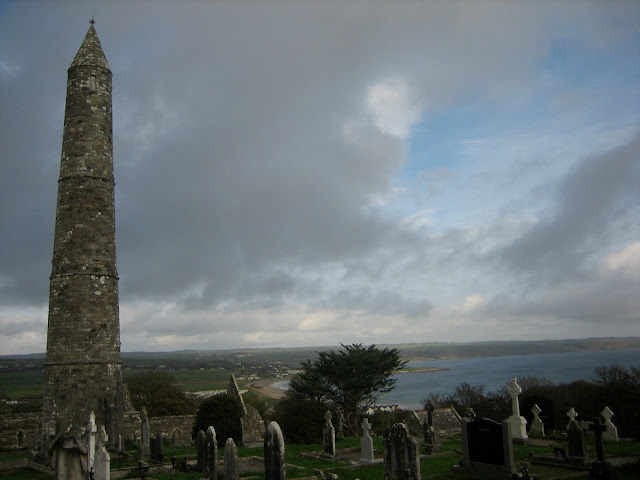

So we spent the night in Dungarvan, where we had a delicious dinner at The Tannery (the portions were rather dainty though), and the next day we drove to Glendalough.

Seanan had never been to Glendalough, which surprised me--I figured it was the sort of place you'd visit on a school field trip even if your parents never took you. It's one of those rare tourist destinations that somehow manages to feel completely unspoiled; but that probably has much to do with it being so near Dublin, so most people only come for the afternoon.
Anyway, we had very nice eating and sleeping there too, at the Wicklow Heather (a great meal every time I've been there) and at Heather House, which is owned by the same folks. The village of Laragh is only a kilometer away, and that's where most of the accommodation is, plus a convenience store and petrol station. I've never been to the pub in Laragh, but I've heard the grub isn't very good. Eating at the Wicklow Heather is a no-brainer. And we got to have breakfast there too!
(I'll post better Glendalough photos at some point. The foliage was really pretty--we were there at the beginning of November--but my pics from this trip don't do it justice.)
Ghost Hunters
 Deborah Blum's Ghost Hunters is quite deceptively named--the subtitle, William James and the Search for Scientific Proof of Life After Death, is more apt. The book follows the life's work of the founding members of the Society for Psychical Research--Frederic Myers, Edmund Gurney, and Henry Sidgwick--along with their American colleague, Harvard psychologist William James (brother of Henry). These scholars were caught between the charlatans of Lily Dale and the hardboiled skeptics of the scientific establishment, whose knee-jerk ridicule of psychical research seems just as dogmatic as those religious leaders who had pooh-poohed the theory of evolution only a few decades before.There are poignant stories aplenty here: images from a dream used to locate the body of a missing teenager; the sad cases of mediums whose early promise dissolved into fakery and alcoholism; and a man obsessed with contacting his long-dead lover, whose golden memory eclipses the presence of his living wife. But the reader finds the scarcity of concrete 'proof' downright frustrating, so just imagine how those tireless researchers of the British and American Psychical Societies must have felt. It's all too fitting that these scholars should ultimately provide the most compelling evidence in the book--that is to say, their own after-death communication.After the extraordinarily dedicated Australian researcher Richard Hodgson died of a heart attack on the handball court, he spoke to his old friend William James via the Boston medium Leonora Piper:
I am happy exceedingly difficult to come very. I understand why Myers came seldom. I must leave. I cannot stay. I cannot remain today.
The spirits of Gurney and Myers expressed this frustration in the cross correspondences experiment, which is the only one I found truly convincing. Several mediums separated by hundreds (or thousands) of miles, with no contact at all between them, came up with the eeriest corresponding messages using automatic writing. This "unlikely kind of chain letter from the dead" seems way too eerie for coincidence, really fascinating stuff. Anyway, I found it amusing how the spirits of the former psychical researchers sometimes took on the tone of short-tempered schoolmasters when talking to the mediums:
"Back in the old despondency," read one passage, taken down by Alice Fleming and signed 'Edmund Gurney.' "Why don't you write daily? You seem to form habits only to break them."Mrs. Fleming told Alice Johnson that the complaint spilled out after she had been too busy to spare time for automatic writing. "If you don't care to try every day for a short period of time, better drop it all together. It's like making appointments and not keeping them," the Gurney message continued. 'You endanger your own powers of sensitiveness and annoy us bitterly."Some of the messages signed by Myers seethed with frustration: "Yet another attempt to run the blockade--to strive to get a message through--how can I make your hand docile enough--how can I convince them?"The nearest simile I can find to express the difficulties of sending a message is that I appear to be standing behind a sheet of frosted glass--which blurs sight and deadens sound--dictating feebly--to a reluctant and somewhat obtuse secretary."A terrible feeling of impotence burdens me."
Ghost Hunters reinforced for me Jim Harold's belief that the paranormal of today is merely the science of tomorrow--or, put another way: "the unbelief of the educated classes...will be found by succeeding ages, to have been nothing better than unreasoning and unreasonable prejudice." That's from a Mr. Joshua Proctor, one of the correspondents quoted in Catherine Crowe's The Night-Side of Nature--a bestselling collection of supposedly-true ghost stories first published in 1848. I'll be blogging about that book next.
Adventures in Germany: Ottobeuren
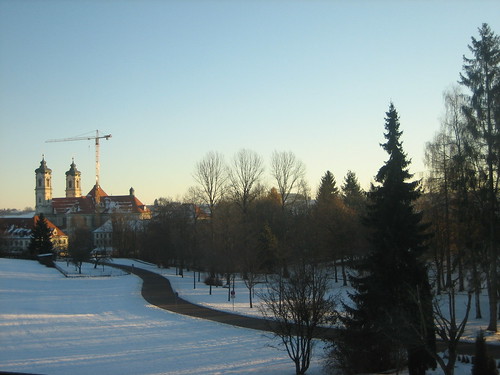
My first stop in Bavaria was a little town called Ottobeuren, known for its huge Benedictine monastery. Here's an early-morning view of the basilica from my hotel window:
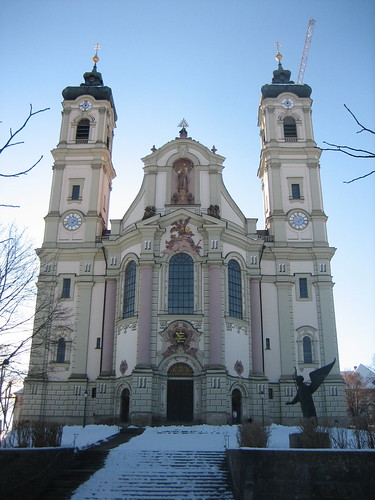
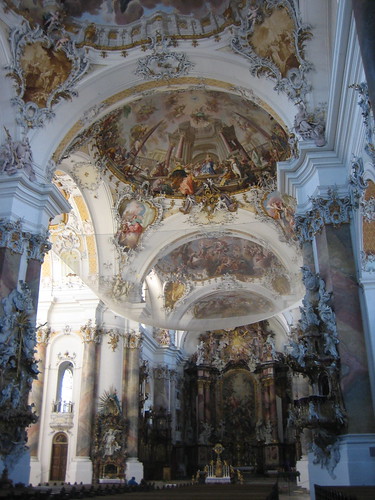 There are a couple reasons why I came here. I first heard about Ottobeuren while listening to A Spy at the Heart of the Third Reich: the most valuable Allied spy of World War II, Fritz Kolbe, stayed here for a few days and was able to photograph his documents in the perfect privacy of the monastery library. (The narrator pronounced it Ott-oh-byur-in, but the bus driver didn't understand me when I pronounced it that way. Apparently it's Ott-oh-bway-rin.)Anyway, I was intrigued by the monastery's description in the book, and when I googled it, I found another item of interest in the basilica: the complete skeletons of four obscure saints reclining in glass coffins, plus a lot of skulls and other bones in smaller glass cases (the skull of Saint Apollonia, for instance, is crowned with a wreath of jewels). Check out what's left of Saint Maurus below:
 I know, it's not a very detailed photograph, but I couldn't bring myself to take any pictures at close range. These glass coffins were horrifying and wonderful all at once. It made me wonder who had exhumed these early saints, wired their bones together, and dressed them in velvet so they could be displayed like this.According to the website, the monastery library and museum should have been open, but the door was locked and I was too timid to ask the lady at the gift shop if she spoke English. The sign said both gift shop and museum were closed for lunch, but lunchtime was over by the time I visited. I really should have asked, so that at least I would have known for sure that the museum was closed for the winter (or perhaps because of the construction). This is something I struggle with when I travel--this ridiculous timidity. I've come all this way...why not stick out my neck just a little bit further?Otherwise, Ottobeuren is a quiet, pleasant little town with a few spa-hotels. I was a bit taken aback when I checked my credit card bill to find my stay at the Hotel St. Ulrich was listed as "SANATORIUM OTTOBEUREN"! My room was adorable and cozy, and because I only really came to check out the church and monastery (and there wasn't much else to do anyway), I ended up spending quite a bit of time curled up with my laptop. It was a very productive trip.Here's a little shrine to St. Ulrich on the path from the church to the hotel:
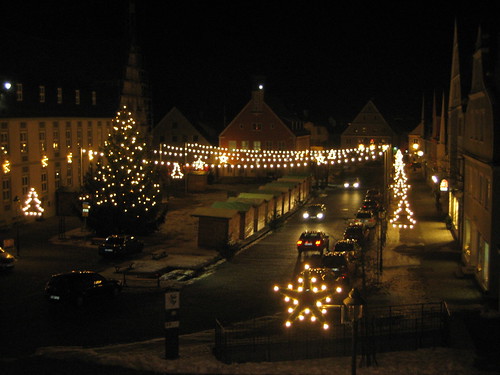
 And here's Ottobeuren's Marketplatz by night:
 My time here was wonderfully relaxing, and it was really neat to be able to walk the halls Fritz Kolbe walked sixty-odd years ago. I'm not sure yet how the visit will inform my fiction, but it certainly will somehow.Next post: Nuremberg and more pictures of the Christkindlesmarkt!
a recipe for Chai tea
Rural Cavan seems like the last place you'd expect to find a Tibetan Buddhist retreat, doesn't it? Jampa Ling is located in a Georgian mansion outside the village of Bawnboy, not too far from the Northern border, and my two days there were a highlight of my spring '06 research trip for Moon Ireland. Some folks pay for room and board and others volunteer their time (and some work and make a donation), and there are regular prayer-times and some of the most delicious homecooked vegetarian food I've ever had. I met a lovely guy named David who made chai for us all, and was kind enough to provide me with the recipe. Once you've made chai from scratch you'll never want to go back to teabags.Ideally you'd have a mortar and pestle to crush the ginger and cardamom seeds, as well as a strainer. Quantities of most ingredients are to taste.
Cleansing Chai Tea3 sticks of cinnamon3 whole clovesginger, crushedcardamom seeds, broken openfennelnatural sweetener (raw sugar or agave)non-dairy milk (optional)Add spices to water in a saucepan and slow-boil for twenty minutes or more. If you're going to add milk afterwards, let the tea come to a boil two or three times before straining so that the flavor holds up against the milk. Pour mixture through strainer into teacups and add sugar to sweeten.
(Note: this recipe was veganized on August 19, 2013.)