Thoughts on Criticism and Rejection
Rejection is hard. It gets a little easier as you go on, but not by much. The sooner you start to devise little coping strategies to keep your ego patched, the better off you'll be.Whenever I got to feeling down over a rejection (or, later on, a snarky Amazon review), I thought: Well, the person who is criticizing me [an editor, reviewer, or random reader] can't do what I'm doing--they don't have the guts, or the talent, or either of the two. This may sound snarky in its own right, and maybe it is. It also isn't fair to all those wonderfully talented editors and agents out there, those midwives and shepherds of the literary world. Then again, I've found that the most talented editors and agents in the business do not write rejection letters that leave you feeling like a sack of elephant crap. Those are the letters--tactful, and sometimes even very encouraging--that spur you on.This attitude I'm talking about--THEY can't do it and therefore I should take their criticism with a grain of salt--is merely a coping strategy. I'm not talking about the criticism that you know in your heart is wise and right on the money. This is just something to keep in mind when you start feeling like you've seriously overestimated your own talent. Even if you've written the sloppiest, most derivative novel ever put to paper, a manuscript that will never see publication, you've still accomplished more than most folks ever do.I'm not discounting the job of reviewers. Literary criticism is as necessary as literature itself, and can be every bit as enjoyable to read. It just drives me nuts when I read a snarky review. It's like when a reviewer takes pains to include some line about Mary Modern not holding a candle to the original Frankenstein. First of all, it's NOT Frankenstein, nor is it a retelling. Nobody was claiming on the dust jacket or marketing materials that I wrote an instant classic. It comes off sounding like a jab, and it's completely unnecessary. In another case, a reviewer dismissed my characters as ciphers--never mind that I can tell you every character in that book is based on a person (or, more often, a series of people) I've known in real life. As I read that particular review, it was abundantly clear that the reviewer had decided not to like my book before he even cracked the spine.You definitely start to sense a bit of envy between the lines of these reviews sometimes. Perhaps the reviewer is himself a frustrated fiction writer, so he says your work is derivative, mediocre, or what have you. Mind you, I'm not whining or being underhandedly smug here--I'm saying this because I often felt this impulse myself before I was published. I have taken notice of several literary catfights in recent years, most memorably between Laura Miller of Salon.com and the novelist Chuck Palahniuk. She wrote a review of Diary in 2003 that was so unbelievably negative it was downright undignified, and he responded with a letter to the editor that had me jumping with glee:I have never responded to a review, perhaps because I've never gotten such a cruel and mean-spirited one. Please send me a copy of your latest book. I'd love to read it.Until you can create something that captivates people, I'd invite you to just shut up. It's easy to attack and destroy an act of creation. It's a lot more difficult to perform one. I'd also invite you to read the reviews Fitzgerald got for "Gatsby" from dull, sad, bitter people -- like yourself.Amen, Chuck.(By the way, I haven't read any of Mr. Palahniuk's novels, but I don't care if Diary was the worst piece of tripe published in this or any other century; nothing could justify the writing of probably the nastiest, snarkiest piece of "journalism" I have ever read. Even this Salon critic's less controversial columns have really annoyed me from time to time--like when she dismissed David Mitchell's Cloud Atlas--which is an utterly sublime novel--as an albeit-fun pastiche. She's sounding more and more like a frustrated novelist, eh?)Anyway, the upshot of all this is that one must read a book review with a critical eye. Sometimes reviewers are needlessly harsh for reasons that have more to do with them than the author, and sometimes there are good reviews of mediocre books written by acolytes. Sometimes there are reviews of books by great writers that are criticized by novelists whose work is patently inferior, or a novelist who is insecure about her own place in the literary canon and acts on an urge to cut down a fellow author. And sometimes, once in a blue moon it seems, there's a thoughtful review written by someone with no angle at all.But that's not the real reason I've stopped reading book reviews. The real reason is that avoiding them is another coping strategy for me--otherwise I'd be reading glowing reviews of books with rehashed plots thinking, Damn it, why did this newspaper ignore my book? Also, I stopped reading the Amazon/Librarything/whatever reviews not too long after Mary Modern was published. There are some really ridiculous ones out there--there's at least one two-star review that spells my name "Deangeiiis," and says my book was poorly edited without even bothering to make a logical case for the assertion. WHO takes these people seriously? Who? Not me, that's who--those crappy, illogical, useless reviews can only raise my blood pressure.
More stuff to spook you
While I was writing Mary Modern I often took breaks in the middle of the night to read the supposedly true ghost stories at Castle of Spirits. This scary-story habit definitely flavored my fiction. I thought I'd post links to a couple of my very favorite stories, "Happy Birthday, Mr. Poe," "A Voice in the Attic," and "A Song for Clara." "A Voice in the Attic" freaked the crap out of me, so consider yourself warned.Another story that made a profound impression on me is Le Fanu's "Strange Event in the Life of Schalken the Painter" (you can also listen to it at Librivox, but unfortunately the sound quality is poor). Schalken was a real-life artist in the 17th century, whose eerie portraits of girls in candlelight inspired this tale of a poor young artist's apprentice struggling to free his beloved from the greedy grip of a very rich, very frightening old man.There are other good stories in the Librivox Ghost Story Collection #1 (click same link above), particularly E. Nesbit's "Man-Size in Marble" and "Uncle Abraham's Romance." Edith Nesbit is best known for her children's fiction--thanks to Ailbhe for giving me a copy of The Enchanted Castle!--but I'm finding her ghost stories even more enjoyable. I've got to pick up a copy of The Power of Darkness, a new collection of the same stories originally published as Grim Tales in 1893.One last note: before you wonder if any of this is appropriate bedtime reading, I'd just like to mention that I finally read Flannery O'Connor's "A Good Man is Hard to Find" the other night. I can see why she's considered one of the 20th-century masters of the short story, but damn, was it ever disturbing. I had to read a few more ghost stories on Castle of Spirits just to try to clear my head.
Cúirt, finally
Cúirt (roughly pronounced "corch") is Galway's international literary festival. It's a really exciting time to be here. Sometimes there are famous authors you can't wait to see and sometimes you discover the work of a new writer, and even if you don't attend a single reading there's still lots of craic to be had at the pub afterwards. It is very much a literary festival though--hugely 'prestigious' to the point where the festival committee won't ask any writer who's garnered 'too much' commercial success. Some folks are pretentious (more the hobnobbers than the writers themselves), but the rest of us feel free to make fun of them.This year the speaker I was most excited about was Samantha Power, Pulitzer Prize-winning journalist and former foreign policy adviser to Barack Obama. I couldn't believe tickets for this event were only €6! And let me tell you, she is AMAZING. Not only is she incredibly smart and articulate--you'd expect that from a Pulitzer winner, right?--but she is also unbelievably humble. Everything she said impressed me. She read a short excerpt from her new book, Chasing the Flame, but she spent most of the hour beforehand giving us clear and thorough background information without aid of a single notecard.There was a Q&A afterwards and naturally people asked plenty of asinine questions, all of which she answered with grace and humor. One guy asked, "If Obama is elected, how long do you think it will be before there's an attempt made on his life?" There was a general hmmph of disdain from the rest of the theater as Ms. Power answered (paraphrasing here), "The concise answer to that is, I don't know."As for the Pulitzer, she very candidly told one audience member that she believes the reason she won is that the judges probably felt like they were "doing something" positive just by giving the award and thus raising people's awareness that genocide is still happening. A Problem from Hell was rejected by something like twenty-two publishers.I have a copy of A Problem from Hell, but I probably wouldn't have asked her to sign it even if I had brought it with me. Whenever I meet an author, even if it's an author I haven't read yet (and thus, haven't had the chance to become speechless with awe over), I always manage to say something stupid. (This goes for musicians, too, which is part of why I didn't stick around after the Elbow show even though I'd brought one of their CDs with me.) I've gotten to the point where I'd rather just avoid any opportunity to put my foot in my mouth.Galway is a great city for festivals in general--the Arts festival program is being launched tonight. Loads of plays, concerts, and art the last two weeks of July!
Another audio treat: The Canterville Ghost by Oscar Wilde
I remember seeing a TV movie version of "The Canterville Ghost" starring George C. Scott in the '80s, but it's taken me this long to read Wilde's original short story, a delightful gothic satire. Sir Simon de Canterville murdered his wife in 1575, and since his own mysterious demise he has taken great relish in terrorizing his descendants at Canterville Chase. Finally fed up, the last lord of Canterville sells the estate to a pragmatic American minister and his family, none of whom are the least bit frightened by the ghost's theatrics.
With the enthusiastic egotism of the true artist, he went over his most celebrated performances, and smiled bitterly to himself as he recalled to mind his last appearance as "Red Reuben, or the Strangled Babe," his début as "Guant Gibeon, the Blood-sucker of Bexley Moor," and the furore he had excited one lovely June evening by merely playing ninepins with his own bones upon the lawn-tennis ground...
Listen on Librivox or read it at Project Gutenberg.
The Mortal Immortal
This evening I stumbled upon a delicious short story by Mary Shelley called "The Mortal Immortal." I listened to the Librivox recording (read by David Barnes, who has a very soothing English accent) while knitting.
Mary Modern has an obvious debt to Frankenstein, and yet I'm unfamiliar with any of her other works. Her personal life fascinates me though--I've heard much about her writing Frankenstein at a very young age (18?) as part of a scary-story competition during a house party (if one could call it that) in some great gloomy castle with Shelley and a few of their friends, and about how Shelley left his wife for her and wife #1 had to commit suicide before they could marry (though they already had a couple kids together by that time); but the story that really intrigues me has to do with the young Mary bringing her books to the graveyard to study at the grave of her mother, Mary Wollstonecraft, and how she and Percy Shelley had their illicit meetings there. It really sounds like Mary Shelley not only wrote gothic stories--she lived one as well.
Anyway, read or listen to "The Mortal Immortal." It's wonderful.
Let the Christmas knitting commence!
I have promised myself I'm not going to be knitting frantically three days before Christmas. Here's what I have to show for myself so far: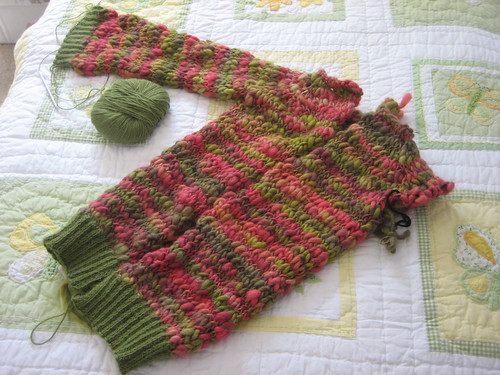 I only started this cardigan a few days ago--big yarn + big needles = fast progress. It's the Thick-and-Thin cardigan coat out of Stefanie Japel's Fitted Knits, and it's for my grandmother.(Actually, I have more done on the Christmas knitting than this, but I can't post them until the end of December because the recipients are reading...)
A little fish meets a Big Fish
 [Haven't forgotten to write about Cúirt. Next time!]I want to tell you a really cool story that begins more than four years ago now. My father handed me the USA Today books section and pointed to this article about novelist Daniel Wallace and Big Fish. In the interview, Mr. Wallace expresses amazement at the eventual runaway success of his novel, and talks about how much he enjoyed his cameo in Tim Burton's big screen adaptation. I had seen the film with my father and we both enjoyed it very much.But the real reason he pointed me to the article was this: Mr. Wallace told the interviewer he had written five novels before Big Fish, all of which had been rejected by publishers. At the time, my Practice Novel was generating quite a high stack of rejection letters and I was feeling depressed about it. My dad told me to take heart, that perseverance would eventually bring success, and this article was proof of it. At first I thought, "I think I can write one more novel, and if that novel is rejected, then I'm at the end of my rope." Then I thought, "If Daniel Wallace can write five novels and break out with the sixth, then maybe I can too." Anyway, I stuck with it, and Novel #2 turned out pretty well for me (tee hee). When I gave advice to other writers, I always emphasized perseverance--precisely because of this USA Today article and Daniel Wallace's story.Fast forward to October 2007. I'd published Mary Modern a few months back and now I was on my way to the Midwest Literary Festival, my first ever (and let me tell you, I was so excited). Daniel Wallace was also attending, though I didn't expect I'd get the opportunity to thank him for his inspiration. I'd be too intimidated, anyway. Well, I actually did meet Daniel Wallace in the backseat of a van on our way to the authors' welcome barbecue, but I, ever-clueless, had it in my head that this guy whose hand I'd just shaken was a literary agent (in fairness, he was only introduced to me as "Dan"). Anyway, I eventually realized who he was, and wondered if I'd be able to talk to him, though I was still feeling a little intimidated. (There were so many established writers at this festival that it was hard not to feel a little mouse-like at first, though I quickly relaxed when I realized just how nice and down-to-earth they all were.)On the last day of the festival, they had scheduled me for a panel discussion that was going to end right around the time I needed to be taking a car back to the airport. I booked it out of the conference center and down a few blocks back to the hotel to pick up my bags. When I got there, I saw the appointed Lincoln town car, and then I saw Daniel Wallace right beside it. We were going to be sharing a ride to the airport! I couldn't believe the serendipity of it.As I loaded my bags he said something to the effect of, Are we going to have a chat? I'd like to have a chat but if you'd rather not I just want to know in advance. SO NICE! Of course I want to have a chat, I said. So on the way to the airport I told him the story I've just told you, about how much that USA Today article meant to me. He actually seemed rather taken aback--he is just such a genuinely humble guy. I said, "If my dad had pointed to that article and said, 'Three and a half years from now you'll be riding in the backseat of a Lincoln town car with Daniel Wallace, talking about your publishers and teaching creative writing classes,' I would never have believed him."So that's my little story of how perseverance pays off.
More on travel-writing (this is a long one)
This morning my sister pointed me to a very interesting feature article on a confessional memoir by a Lonely Planet researcher called Do Travel Writers Go to Hell? People are asking questions about how thoroughly (and ethically) the guidebooks they use are actually researched, and rightly so. Apparently this writer accepted lots of freebies and engaged in plenty of drugs and sex along the way, and while it's safe to say most guidebook writers are far more responsible than this guy was, there is a great deal of truth in some of the things he's saying. This, for example (from the WaPo article, not the memoir itself), is 100% true:[Kohnstamm] says he's being criticized because he revealed guidebooks' dirty little secret: Authors can't get to every place they're expected to review because publishers don't give them enough time or money to do the job properly. So, he says, he was forced to do a "mosaic job," relying in some cases on information from local contacts, fellow travelers and the Internet.Even the most responsible guidebook writer has to resort to these tactics. I worked really hard on Moon Ireland, but I still had to rely on secondhand information far more often than I was comfortable with. I'll elaborate.First of all, here's the number 1 rule of guidebook-writing: don't expect to make any money. You will subsist and that is all. Number 2: taking freebies is unacceptable. I had to accept comps everywhere I went while I was researching Hanging Out in Ireland back in college, because they gave us all of $3500 to research half the country (originally the fee was going to be $2500, but my co-writer held out for more money. Thank goodness for Tom, who was older than I was and far more sensible). My editors encouraged us to accept freebies because otherwise we'd run out of money after two weeks and we were there for five to seven (only five, in my case--can you imagine covering half of Ireland in five weeks? They told me I'd have to do some fudging. Yes, my own editors told me to cut corners.) This was a shoestring guide on a shoestring budget.Even putting that question of ethics aside, accepting a free meal, room, or tour will not give you an accurate idea of the level of service a typical tourist will receive. You don't want to say "yeah, this place is great!", when the owner is actually not a nice person at all, but was only kissing your butt because you're a guidebook writer.How do I know this? I've admitted I accepted freebies from hostels and restaurants every place I went for Hanging Out, but that's not how I know. In May 2006 I visited--or attempted to visit--a very upscale B&B (with its own gardens open to the public) off the Ring of Kerry, and was shooed away by the owner, who is hands down the meanest person I have ever encountered in Ireland (though incidentally, she is not Irish). There had been a storm the night before, and the garden was closed because of damages. There was a huge sign saying so, but the gate to the house was open. I drove through the gate and was met on the road by this nasty woman, who demanded I get off her property even when I tried to explain that I was writing for a guidebook and was interested in the B&B. I don't think she even heard what I was saying, she just kept snarling that the B&B was fully booked and to get out immediately. Let me impress upon you (as if I haven't already): this woman's behavior was HORRIBLE and I would discourage anyone from staying at that B&B no matter how luxurious it might be. So imagine my disgust when I opened Lucinda O'Sullivan's guide to Irish B&Bs and noticed she'd written about just how lovely and kind the proprietor is. Someday I'm going to write Lucinda O'Sullivan and tell her how disappointed I am in her book. (If anyone is interested in knowing which B&B I am talking about, please feel free to email me. I just don't want to mention it by name and get a pile of angry emails over it.)Out of necessity, I was doing much of my research during low season, when many B&Bs and restaurants were closed, only open weekends, or whatever. Say I stopped on a weekday night in February at a certain B&B, and the proprietor heartily recommended a restaurant in town. I got to the restaurant and found it was only open on weekends until after Easter. So instead, I had pub grub for dinner--adequate, nothing to write home about--and both the pub ('steaks, seafood, and paninis, gets the job done') and the restaurant ('run by an Irishman and his French wife, Continental cuisine, much loved by locals') would get write-ups. Other times I could only budget one night in a certain town, but I might need to write up five accommodations. How could I possibly do this without spending five nights in this town? I couldn't, of course. I might just stop by and have a chat with the proprietor (which would usually turn into a two-hour gab because the lady would be very eager to impress me, so I didn't do this too often because it would eat into my sightseeing time too much--see, I couldn't stop by and ask to take a look around without telling them I was writing a guidebook); or, more often, I might hear of a good B&B from other travelers, or other guidebooks, or Trip Advisor, and do as much internet research as I could to be reasonably certain the accommodation was worth recommending. Then I pledged to visit the place and stay there myself for the second edition. That was the absolute best I could do under the time and financial constraints. I'm not happy about it, but at least I know that, since I'm the sole author of Moon Ireland, I can make sure all the info in the new edition is gathered firsthand. I'm going to go through the whole book before the revision process starts and highlight every pub, restaurant, and B&B I need to visit, and then I'm going to do it. This is a big part of why I think the Moon guides are so great--they're written by only one person, or a team of two, and I believe that higher level of personal responsibility ultimately leads to a more reliable guidebook. Lonely Planet is generally my go-to guide for other locations, but it does bug me sometimes that they don't delete/update write-ups of accommodations and restaurants that have closed (or moved to another location) years ago.According to this WaPo article, Moon researchers get above-average advances, and I believe it. Even though I lost money doing this guidebook (for Ireland is the second-most expensive country in Europe), I couldn't have reasonably expected any more than they gave me--after all, guidebooks have an awfully short shelf life. Mine has been out one year, and already I've found several restaurants that have closed in Galway City alone. It's not an old guidebook, but it's already out of date (come to think of it, these books are out of date even before they're published). When I'm in the travel section at Borders looking to plan my next vacation, I always look at the pub dates on the guidebooks I have to choose from. If I were a tourist looking for an Ireland guidebook, I might pick up a 2008 edition of some other guidebook instead of Moon Ireland. (Even so, the 2008 guidebooks are the product of research done in 2006 or early 2007.) What I'm trying to say is, I don't even think I'm going to earn out on the advance Avalon gave me. The pay is tight because the operation doesn't float if they pay you a liveable wage.Tourists should keep all this in mind. But know this: we travel writers may not be perfect, but we're travelers just like you, so we understand how important a reliable guidebook is in making your vacation a happy one.
a recipe for Chai tea
Rural Cavan seems like the last place you'd expect to find a Tibetan Buddhist retreat, doesn't it? Jampa Ling is located in a Georgian mansion outside the village of Bawnboy, not too far from the Northern border, and my two days there were a highlight of my spring '06 research trip for Moon Ireland. Some folks pay for room and board and others volunteer their time (and some work and make a donation), and there are regular prayer-times and some of the most delicious homecooked vegetarian food I've ever had. I met a lovely guy named David who made chai for us all, and was kind enough to provide me with the recipe. Once you've made chai from scratch you'll never want to go back to teabags.Ideally you'd have a mortar and pestle to crush the ginger and cardamom seeds, as well as a strainer. Quantities of most ingredients are to taste.
Cleansing Chai Tea3 sticks of cinnamon3 whole clovesginger, crushedcardamom seeds, broken openfennelnatural sweetener (raw sugar or agave)non-dairy milk (optional)Add spices to water in a saucepan and slow-boil for twenty minutes or more. If you're going to add milk afterwards, let the tea come to a boil two or three times before straining so that the flavor holds up against the milk. Pour mixture through strainer into teacups and add sugar to sweeten.
(Note: this recipe was veganized on August 19, 2013.)
Who loves your feets?
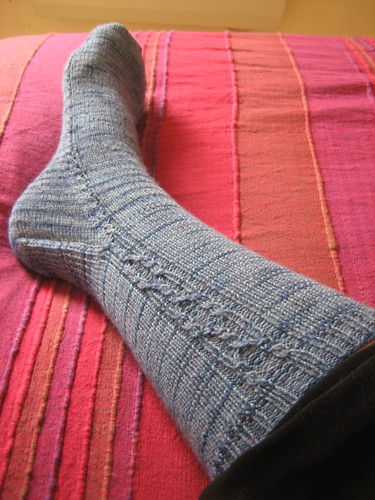 So far I haven't blogged much about knitting because...well, I'm still in blogging practice mode, which means I have maybe two-point-five regular readers, all of whom I have already bored with talk of what's on my needles.I am rather proud of my first pair of socks (pattern by the Yarn Harlot) though. They were for Brendan, but I'm modeling them here (pre-blocking) because I was impatient to get a photo up on Ravelry. He says they fit like a pair of gloves. Hooray!
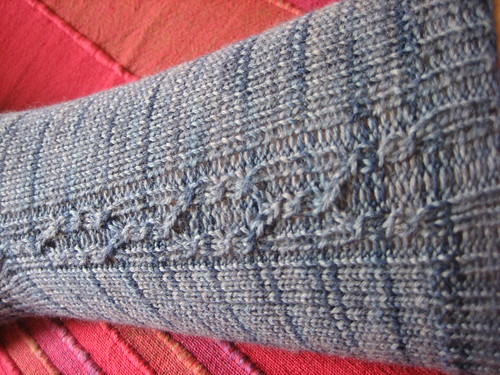 I can see myself getting totally addicted to sock-knitting. This reminds me of an op-ed (if you can even call it that) I wrote for the Washington Square News entitled "Trash Your Panties: Going Commando with Camille." (I was going to say it was tongue-in-cheek but that sounds a little dirty under the circumstances...) Anyway, towards the end of the piece I suggested that socks replace ladies' underpants as fetish objects:I recommend socks for their wintry practicality and distance from the danger zone.I should dig out that piece and post it here sometime. It was one of the better things I wrote for the paper at NYU (sadly enough).
 (I've just finished this pair for Seanan. Pattern here.)
Next entry will be all about Cúirt, the international literary festival going on right now in Galway.
Two Days in Dublin
Brendan and I went to Dublin for a couple of days to see Elbow at Vicar Street Monday night. The concert was fantastic. I've heard it said more than once that the true test of a band's talent is if they sound even better live than they do on the album, and this was definitely the case. I'll write more about Elbow later though. Here is another little photo essay from the last couple days.
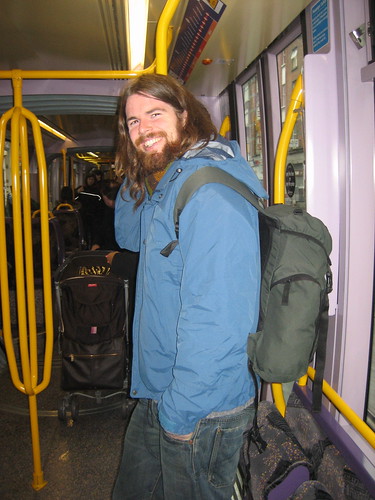
 (You know how much I usually deplore this sort of couple-y smugness, but I think the artistic value of this shot makes it worth including.)
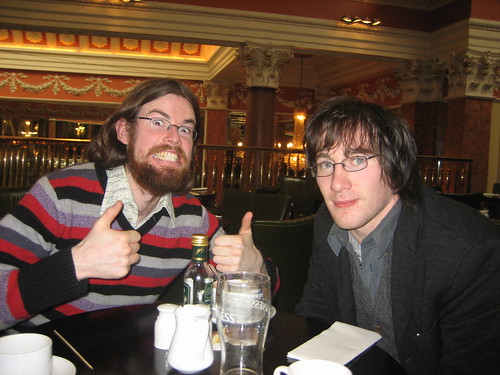 Brendan and Diarmuid after lunch at The Bank on Dame Street. Probably the best gastropub in Dublin--food, service, and original nouveau decor all awesome.
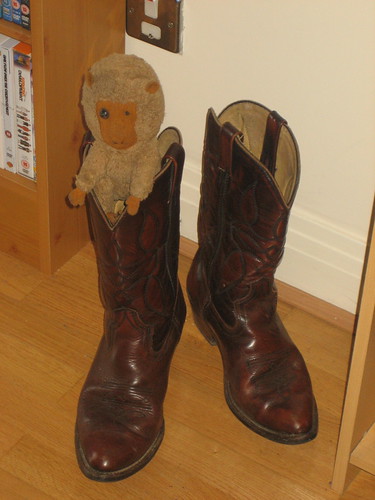 Shitmonkey: the only toy Diarmuid and his brother Donnacha ever had, apart from a Lego set.
And here are some shots taken from the balcony at the Elbow concert:


Thoughts on the Creative Cycle
Until recently my website bio concluded with the following line:At the moment Camille is working on a new novel that will feature chocolatiers, burlesque dancers, antiques dealers, pyromaniacs, and a runaway snow globe, though not necessarily in that order.Tongue-in-cheek, but only to a point. At the time I wrote that I was doing a lot of random reading and wasn't quite sure what I wanted to write about. Since this is novel #3 for me, I have enough of a work history now to notice a pattern of peaks and troughs in my creativity. I have never finished revising one novel and started writing the new one the following week or month (and I've always wondered about those writers who say they do). In between revising the Practice Novel and beginning Mary Modern there were a good seven or eight months of trying to develop various ideas that ultimately weren't viable, at least in the form I gave them at the time. The Mary Modern-Petty Magic interim period was a good deal longer--partly because I was working on Moon Ireland, but more because I was putting a fair amount of pressure on myself to come up with something that would top Mary Modern. All in all, it was roughly a year between finishing up the guidebook and MM edits and beginning Petty Magic.Even with Mary Modern promotional stuff taken into consideration, 2007 didn't feel like a productive year for me, although I figured even at the time that "trough" was a necessary part of the cycle. All the false starts eventually lead you closer to what you're meant to be working on. In 2007, these false starts took the form of seventy pages of a novel I later realized I could have written five or six years ago (fortunately I could cannibalize the strongest parts, and for two different projects), and the start of another more promising novel that clearly needed more time to simmer. I also wrote a few short stories I will revise at some stage. (As my friend Danny put it: stories, like jelly, need some time to set.)So there seems to be a pattern of filling up (reading eclectically and voraciously; collecting random bits of dialogue/character quirks/fun words/plot jumping-off-points on little scraps of paper - though these bits will eventually work their way into many future stories, not just this one coming up), formulating an idea, writing up a storm, then another eclectic reading and gathering period that well outlasts the novel revisions. (I've read that this cycle is personified by a trinity of Hindu gods: Brahma the creator, Vishnu the preserver, and Shiva the destroyer.)It's that filling-up period that has all the false starts in it. You're trying to write before you know what you actually want (or need, or should) write about. And you know you're in the formulation stage when you start to notice little serendipities: books of particular relevance seem to pop off the shelf, and you may notice subtle links between two seemingly unrelated topics that have both intrigued you lately. There is a definite sense of things falling into place, and a lovely tingling excitement whenever you think of your new Big Idea.That, and relief that you aren't faking it.
more about Waterford
 Towards the end of our holiday weekend in Carrick-on-Suir Brendan and I went to Tramore for the afternoon, and I snapped this photo (he's a teapot, see?) before my camera battery died. I wish I had gotten a shot of the ferris wheel, which we later rode for €3 each (and I think we only went around three times, but it was still worth it).As you can see, Tramore is on the Waterford coast, eight miles south-west of Waterford City. I didn't write it up in the Moon guidebook because I was initially put off by the rather tacky seaside amusements--a large arcade and an amusement park with enough rides to keep the kiddies entertained the whole day through. Tramore feels like the Irish version of Coney Island. While you're on vacation, I thought, why go to a place that feels so much like an American carnival? You get enough hot dogs and spinning teacup rides at home, right? But that's exactly why I enjoyed myself so much, when I actually took the time to see Tramore properly. The sea views were lovely, and being able to look out over the ocean from the top of the ferris wheel made us a really nice memory. I have learned this lesson several times since publishing Moon Ireland: ultimately I'm not doing my readers any great service by making snap judgments. They might be missing out on something cool because I never took the time to investigate it in the first place. I may know Ireland pretty well, but there's so much I haven't seen or experienced yet. I'm looking forward to working on the second edition.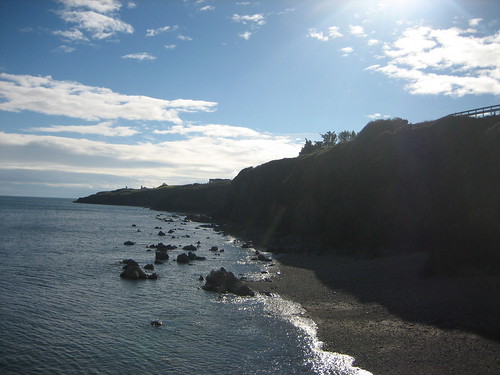
Mahon Falls, take 2
I finally signed up for a YouTube account so I could upload the video I mentioned in my last post. (The quality is much better when I play it on Quicktime. Boo.)
Holiday weekend #2
Let me tell you something about Waterford: if you go down there only to visit the crystal factory, you really ought to be nettle-whipped. The mountains, country roads, and sea views are so, so lovely! (And much of that crystal is now so, so produced in Turkey.)Ponies in a pasture on the River Suir, just outside the town of Carrick-on-Suir (just before the one on the right tried to chomp on Brendan's arm):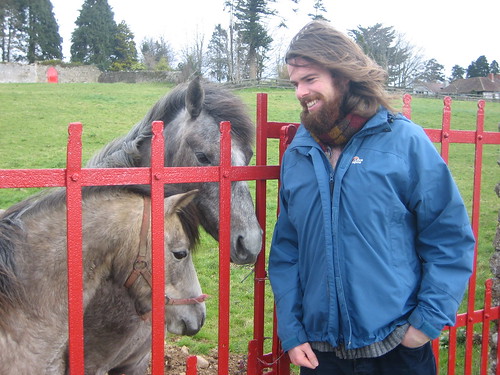 (Carrick-on-Suir is technically in Tipperary, but people have Waterford tags on their cars and root for Waterford sports teams, and the 'Welcome to Waterford' sign is within spitting distance of Brendan's house. Hence my initial confusion over which county Brendan is actually from! Tipperary is also a county of beautiful mountain and pastoral views--see the post before last.)Until this past weekend, Ardmore was my hands-down favorite place in County Waterford, but check out my pics of Mahon Falls in the Comeragh Mountains: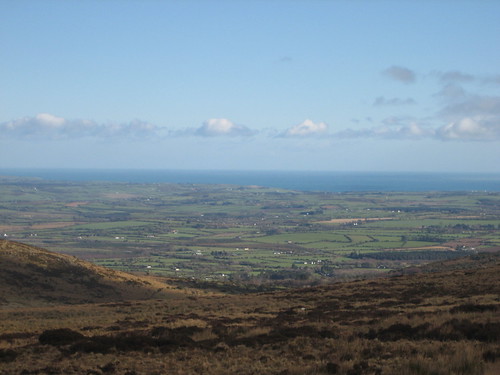

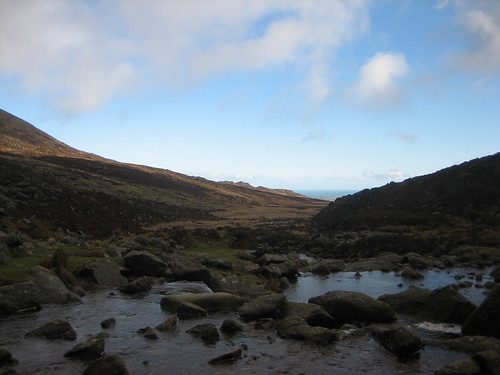 (I also took a panoramic video, but I think it's too large to upload. Drat!) It was awfully cold and blustery up there, but those storm-clouds in the second photo held off until we were back in the car. There were all these grizzled sheep moseying up and down the sheerest mountain-faces, the waterfall was awesome, and there weren't too many other people. After our walk to the falls we kept driving, and the road was spanned by the most complete rainbow I've ever seen.
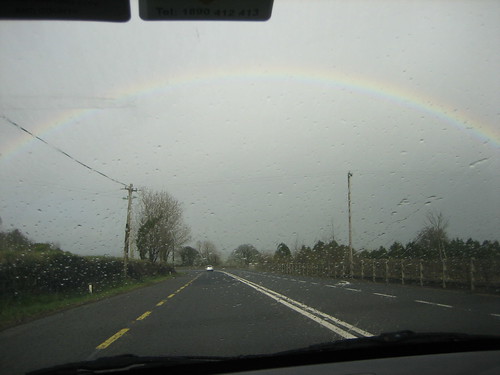
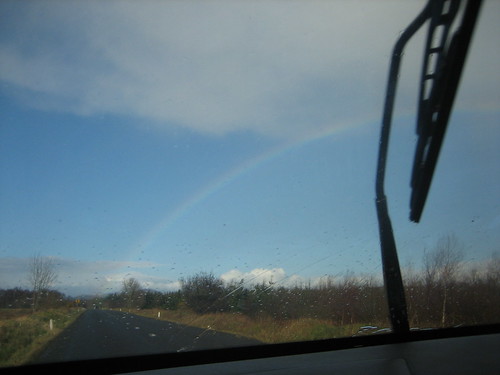 You could actually see where the rainbow ended on both sides.Here are some close-ups of the Harry Clarke windows at the Church of Saints Quan and Broghan, Clonea:
 I'm not sure which saint this is, but here's a detail from the bottom of the same window:
 Actually, there seems to be some uncertainty as to whether the later windows were done by Harry Clarke or Evie Hone. A Google search gave me no answers, and I've left my Harry Clarke book at home. I must look it up at the library. Anyways, from the earlier set (signed J.J. Clarke & Sons), here is St. Brendan the Navigator, along with a picture of a certain name- and beardsake:


...looking slightly less holy.After we visited the church in Clonea, we went to Mothel holy well where the locals walk through the stream seven times on pattern days.
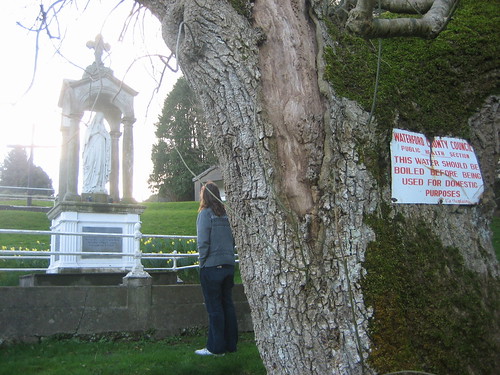 (The well is at the roots of that tree. Notice the sign--apparently the water used to be known for its purity, but it's now contaminated.) There's a small dolmen in the field beyond.
Getting well off the tourist track feels great, doesn't it?
Couldn't Ask for Better Neighbors
I'm back in Tipperary this weekend, at Brendan's parents' house in Carrick-on-Suir for Easter. Here is a view from their backyard: Now, living right beside a graveyard might creep some people out--but the way I see it, there are bodies buried everywhere. These are just the ones that are marked.Last night we were walking into town (so I could sample the spudballs, a local delicacy; alas, there were no more to be had at Fats Quann's takeaway), and as we were passing the graveyard Brendan pointed out the eerie blue lights inside--the same solar-powered lights you can get for your front walk, which charge all day and illuminate the sidewalk at night. If there were any honest-to-God orbs floating about you'd hardly have noticed them.You expect this kind of elaborate grave-tending in a predominantly Catholic country, but I still wonder at the time and expense behind all those rotting wreaths, water-logged flower-globes, sentimental plaques (which often include a photograph of the deceased) and battery-operated candles. It seems like a significant part of Irish culture--something that, unlike the rural custom of forming a digging party when a neighbor passes on, won't be dying out any time soon.(Blame Seanan for the offaly bad pun.)
holiday weekend in Tipperary
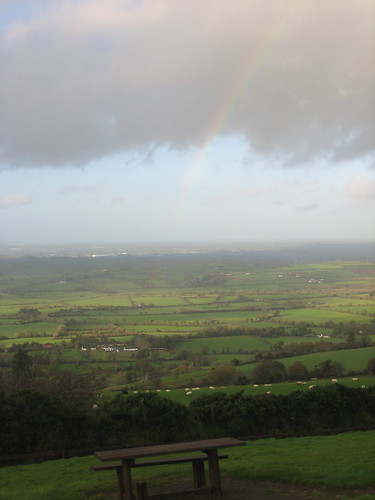
Seeing as I can't stand drunken rowdies and all the noise, stench, broken glass, and damage to public property they leave in their wake, I make a point of getting far away from city pubs on St. Paddy's Day. This year, my friend Seanan was kind enough to invite me and several other friends down to Tipperary for the holiday weekend, and we had a couple of nice long walks in the Silvermines and around Lough Derg (on the Clare side, just north of Killaloe). Seanan also cooked the most amazing dinner ever and we were all very jolly.I didn't bring a camera on this recent Silvermines walk, but here are a couple of photos from the first walk back in October: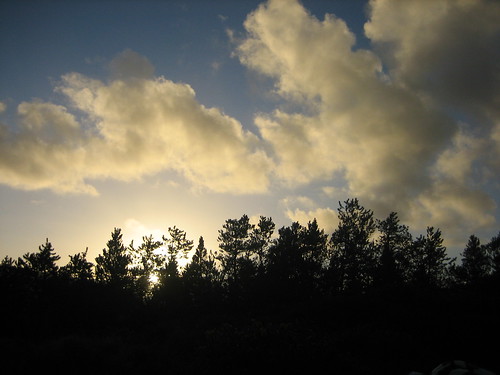 Looks utterly peaceful, right? Well...our walk this past weekend was downright creepy. Seanan's mom dropped the four of us (Seanan, me, Charlene, and Clare) off and would meet us back in the parking lot in two hours. Maybe 45 minutes into our walk, we came upon an SUV on the road (which was barricaded at the entrance--these roads were meant to be vehicle-free, for the most part). Two young men emerged from the brush with an empty wheelbarrow, and while we were still a good bit off they put the wheelbarrow into the back and drove off. We were unnerved by this--what could they have dumped out here?--and after poking around in the brush and finding no corpses or broken-down washing machines we decided to turn around so we wouldn't run into those shady dudes again (and we had to turn around eventually anyway). We were joking that they might come back and kill us all for being witnesses...and then we heard the SUV
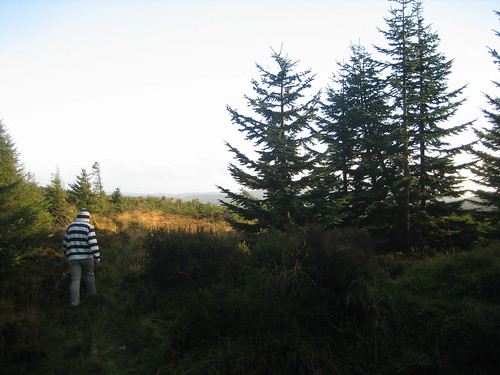 approaching again! It was so quiet we could hear it coming from a ways off, and I decided to jump into the brush and hide behind a tree. I got made fun of afterwards, of course, and it was pointed out that if they had been intending to gun us down surely they'd have noticed there were only three out of four on the road.But that wasn't even the creepy part. On our way down the hill to meet Seanan's mom, we leaned over a stone bridge perched maybe twenty feet over a little stream, and what do you suppose we saw? A dead dog. It was huge and black and its fur was slick with rainwater. We couldn't see its head or rear because they were covered by one of
  those industrial-strength garbage bags. Why in God's name didn't its owner give it a proper burial? It led us to wonder if the poor black dog had met its end by unnatural means. I wanted to call someone--at home you'd call the public works people and someone would come by in a yellow truck to pick it up--but Seanan said it was unlikely anyone would do anything about it. The whole situation was odd, and vaguely sinister. I've seen plenty of dead animals before--sheep carcasses on the beach, having fallen off the cliff above; and all the bodies of birds, seals, and lizards forever proving Darwin right on the Galapagos--but in those cases there wasn't anything more troubling than 'survival of the fittest' at work. Somebody put that dead dog in the stream. It was premeditated. It freaked me out.Other than that--hey! We had a lovely weekend.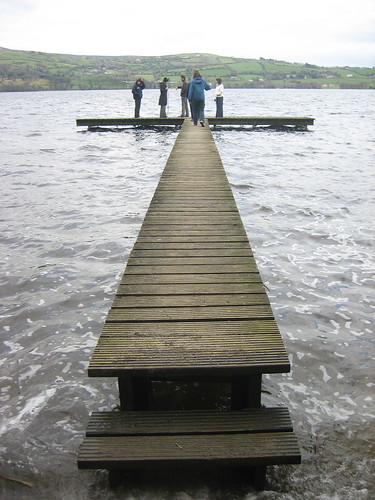
Modern Ireland
 When some people (who've probably never been here) think of Ireland, they have this image in their heads of rolling green hills, pristine lakes, and suchlike. Not to say that image isn't accurate--only that it isn't complete. Take for instance this lovely shopping cart o' refuse Brendan snapped with his camera-phone. This is the kind of stuff you find sludged over on the bottom of the canal here in Galway (though the swans often distract you from noticing it). At least it's tidy...?Seriously though, I had a special section in my Moon guide on environmental issues, and I got fairly disgusted over the course of my research. When you're here on vacation it's easy to forget that even the most beautiful places on Earth have their landfills and tainted drinking water (tainted with what, you don't need to know).
Tom's Midnight Garden
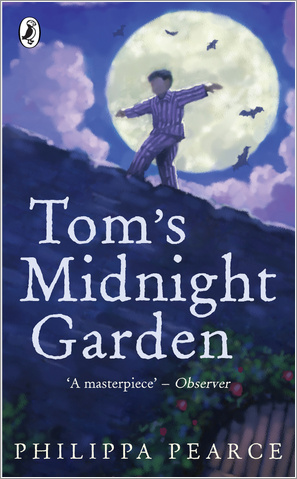 Philippa Pearce published this delightful award-winning English fantasy novel in 1958, and it is a must for any child's bookshelf. It seems like the novel isn't nearly as well known in America.Tom's brother is stricken with the measles, so Tom must spend his summer holidays in a "poky old flat" with his childless aunt and uncle. The flat is a small part of what was once a grand house, but all that remains of its former stateliness is the grandfather clock in the front hall; out the back door are nothing but trash bins and concrete driveways. When the clock strikes thirteen on Tom's first night there, he comes downstairs to investigate, and when he opens the back door he finds a glorious garden with plenty of opportunities for play (Tom is under quarantine, so his indoor daytime existence is stultifying). He forms a lasting bond of friendship with a girl he meets in the garden—the only one of the house and garden's inhabitants who can see him. In rereading this novel I thought more than once of The Time Traveler's Wife:
This was Hatty, exactly the Hatty he knew already, and yet quite a different Hatty, because she was—yes, that was it—a younger Hatty: a very young, forlorn little Hatty whose father and mother had only just died and whose home was, therefore, gone...
He never saw the little Hatty again. He saw the other, older Hatty, as usual, on his next visit to the garden. Neither then nor ever after did he tease her with questions about her parents. When, sometimes, Hatty remembered to stand upon her dignity and act again the old romance of her being a royal exile and prisoner, he did not contradict her.
Months and even years go by between Hatty's seeing Tom in the garden, though he goes there and plays with her every night. And when he gets back to his room in his aunt and uncle's flat after hours of playing in the garden with Hatty, the clock reads just a few minutes past midnight.I first read Tom's Midnight Garden when I was nine or ten years old, and because it was a school copy I couldn't just pull it off the shelf years later when I was wondering about the title and author of that great children's novel I'd read back in Challenge Literature (which was this special once-a-week class for kids with high scores on the standardized tests, or however else they measured our potential. There were four Challenge classes: Math, Literature, Art, and Music. It sounds nerdy, but the Challenge classes were my favorite part of elementary school.) Ailbhe recently mentioned Tom's Midnight Garden over dinner, and I got really excited because I knew it was the same book I'd been searching for on the internet. I got an old library copy via Amazon Marketplace and I've enjoyed it as much as I did when I was nine. Even got a bit teary at the end.Hooray for secondhand books! I like the idea of a book arriving with a history already. This paperback copy is stamped MERRICK LIBRARY, and it has that wonderful musty smell of old paper. On the back cover I see:
DATE DUE:SEP 12 1981JAN 27 1982
And at the bottom:
2¢ PER DAY OVERDUE FINES.OVERDUE NOTICES WILL NOT BE SENT ON THIS PAPERBACK.
I wonder if the second person who took it out never returned it.
I heart Angela Carter
 I am rationing the oeuvre of the great Angela Carter. I always wind up closing her books, sometimes mid-paragraph, shaking my head and getting a little teary-eyed to think that there will be no more of her novels or short stories. Right now I'm reading another story collection of hers, Saints and Strangers (originally published as Black Venus in the UK), and this passage from "The Kitchen Child" is just too lovely not to share:
And, indeed, is there not something holy about a great kitchen? Those vaults of soot-darkened stone far above me, where the hams and strings of onions and bunches of dried herbs dangle, looking somewhat like the regimental banners that unfurl above the aisles of old churches. The cool, echoing flags scrubbed spotless twice a day by votive persons on their knees. The scoured gleam of row upon row of metal vessels dangling from hooks or reposing on their shelves till needed with the air of so many chalices waiting for the celebration of the sacrament of food. And the range like an altar, yes, an altar, before which my mother bowed in perpetual homage, a fringe of sweat upon her upper lip and fire glowing in her cheeks.
Gorgeous.