Galápagos Retrospective
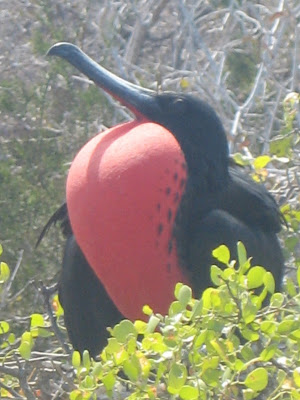 I'm not going to be doing much traveling for awhile, but it seems you guys enjoy the pictures, so I thought I'd share some photos of my Galápagos adventure with Kelly (two years ago this month). It might sound trite, but observing evolution at work, and at such close range, is a profound experience. We had the good fortune to be adopted by a lovely South African family living in London (Nikki, Andrew, and 14-year-old Jamie), and hanging out with them made our trip all the more enjoyable. Even the frustrations (the cockroaches on the boat, the hilariously bad food and creepy cook, the irresponsible behavior of our fellow tourists) fell into the category of 'never a dull moment.' If you ever get a chance to go, DO! (Right: a frigatebird strutting his stuff. The bird life is wonderful--clever little sparrows hopped right up to me whenever I opened my water bottle, and we even spotted a few penguins!)But read Mike D'Orso's Plundering Paradise first. I had the privilege of working on this book while I was at Harper, and I reread it during our trip--it's an engrossing, very personable travelogue touching on the myriad environmental and economic problems wrought by tourism, immoral/illegal fishing practices, and government corruption, all through the eyes of island natives, scientists, and other long-term residents.Anyway, without further ado, here's my little slide show, with a few journal excerpts thrown in.
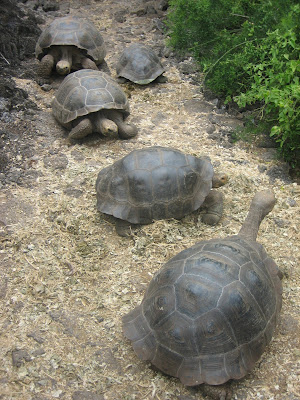 Galápagos tortoises at the Charles Darwin Research Station, Isla Santa Cruz.
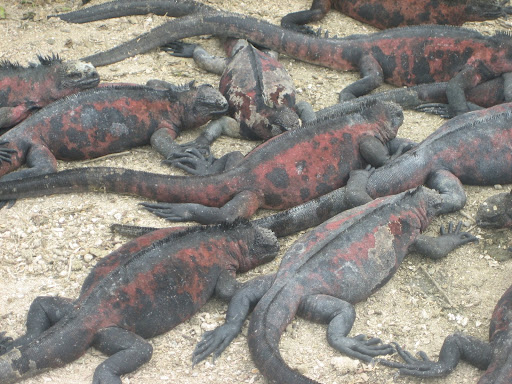
Tuesday, 21 August 2007: "Just got back from our second morning of snorkeling--swam behind a sea turtle for maybe half a minute, saw a few sea urchins and a big indigo-colored fish, then a huge sea lion towards the end. We heard stories of sea lions mistaking people in wet suits for their own species, and even attacking. Yesterday morning I saw a small ray and a wider variety of fish--several schools (makes you feel so serene, watching them swimming in unison); a few pale medium-sized fish streaked with pastel pink, blue, and green; and a larger blue fish lying still beneath a rock."
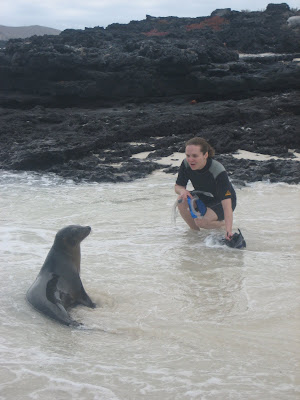 Kelly chillin' with a sea lion.
Thursday, 23 August 2007: "Been having a tremendously good time--never again will I be able to speak the words "he peed in Barbara Bush's coochie" to a family of Jehovah's Witnesses..."
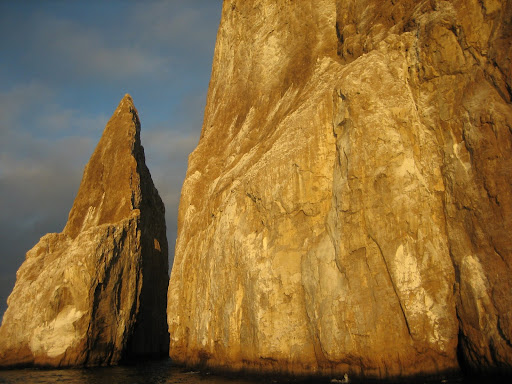 The boat circled Kicker Rock early in the morning--well worth getting up at 6 for, don't you think?
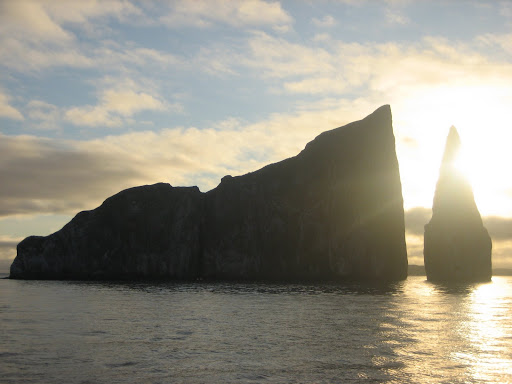
Thursday, 23 August 2007 (later): "Watched a sea lion in labor (for nearly an hour!) Came back from our walk and found mom and pup in the same spot on the beach near the pier. Blood on the sand. Saw waved albatrosses doing their mating dance, clacking beaks like a furious game of hockey. Stunning cliff views..."

Aforementioned beak-hockey mating dance.
 The infamous blue-footed booby.
"Horribly rough passage from Santa Cruz to Santa Fe this afternoon--newcomers were all seasick, and we all felt pretty queasy too. But I laid down and listened to Elbow. Proud of myself for not puking. Delicious hot chocolate served after snorkeling."

Wednesday, 29 August 2007 (back on the mainland): "Last delicious thing we had on that boat, let me tell you..."

Kelly on Isla Bartolome, during the most scenic walk of the trip. Notice rocket-shaped Pinnacle Rock at top right--there's another view of it in the picture below.

Ghost Hunters
 Deborah Blum's Ghost Hunters is quite deceptively named--the subtitle, William James and the Search for Scientific Proof of Life After Death, is more apt. The book follows the life's work of the founding members of the Society for Psychical Research--Frederic Myers, Edmund Gurney, and Henry Sidgwick--along with their American colleague, Harvard psychologist William James (brother of Henry). These scholars were caught between the charlatans of Lily Dale and the hardboiled skeptics of the scientific establishment, whose knee-jerk ridicule of psychical research seems just as dogmatic as those religious leaders who had pooh-poohed the theory of evolution only a few decades before.There are poignant stories aplenty here: images from a dream used to locate the body of a missing teenager; the sad cases of mediums whose early promise dissolved into fakery and alcoholism; and a man obsessed with contacting his long-dead lover, whose golden memory eclipses the presence of his living wife. But the reader finds the scarcity of concrete 'proof' downright frustrating, so just imagine how those tireless researchers of the British and American Psychical Societies must have felt. It's all too fitting that these scholars should ultimately provide the most compelling evidence in the book--that is to say, their own after-death communication.After the extraordinarily dedicated Australian researcher Richard Hodgson died of a heart attack on the handball court, he spoke to his old friend William James via the Boston medium Leonora Piper:
I am happy exceedingly difficult to come very. I understand why Myers came seldom. I must leave. I cannot stay. I cannot remain today.
The spirits of Gurney and Myers expressed this frustration in the cross correspondences experiment, which is the only one I found truly convincing. Several mediums separated by hundreds (or thousands) of miles, with no contact at all between them, came up with the eeriest corresponding messages using automatic writing. This "unlikely kind of chain letter from the dead" seems way too eerie for coincidence, really fascinating stuff. Anyway, I found it amusing how the spirits of the former psychical researchers sometimes took on the tone of short-tempered schoolmasters when talking to the mediums:
"Back in the old despondency," read one passage, taken down by Alice Fleming and signed 'Edmund Gurney.' "Why don't you write daily? You seem to form habits only to break them."Mrs. Fleming told Alice Johnson that the complaint spilled out after she had been too busy to spare time for automatic writing. "If you don't care to try every day for a short period of time, better drop it all together. It's like making appointments and not keeping them," the Gurney message continued. 'You endanger your own powers of sensitiveness and annoy us bitterly."Some of the messages signed by Myers seethed with frustration: "Yet another attempt to run the blockade--to strive to get a message through--how can I make your hand docile enough--how can I convince them?"The nearest simile I can find to express the difficulties of sending a message is that I appear to be standing behind a sheet of frosted glass--which blurs sight and deadens sound--dictating feebly--to a reluctant and somewhat obtuse secretary."A terrible feeling of impotence burdens me."
Ghost Hunters reinforced for me Jim Harold's belief that the paranormal of today is merely the science of tomorrow--or, put another way: "the unbelief of the educated classes...will be found by succeeding ages, to have been nothing better than unreasoning and unreasonable prejudice." That's from a Mr. Joshua Proctor, one of the correspondents quoted in Catherine Crowe's The Night-Side of Nature--a bestselling collection of supposedly-true ghost stories first published in 1848. I'll be blogging about that book next.
Great Book #70: The Third Policeman
 Even if I'd read The Third Policeman before I'd heard anything about Brian O'Nolan (a.k.a. Flann O'Brien, Myles na gCopaleen, et al.), I still would have figured the author was a total character. 'Maddening' is one of many adjectives used on the back cover, and it's certainly the most apt.The unnamed narrator tells us of his claustrophobic existence somewhere in rural Ireland, and of his relationship with the leech-like John Divney, who's taken over his dead parents' farm and refuses to leave. Divney hatches a plan to murder a local miser, Mathers, and steal his money, and the hapless narrator agrees.After returning to the house of the dead-and-buried miser to retrieve the money box, the narrator encounters Mathers in a dirty old bathrobe sipping watered-down tea. The money box has disappeared, and needless to say the narrator can't really be asking the inexplicably-alive-or-maybe-undead Mathers where it is. So he goes to the local police station thinking he'll claim he's lost his (nonexistent) American gold watch, and get the policemen's help finding the money box instead. There are a pair of cartoonish policemen at the station, and they spend a lot of time blabbing about humans who are part-bicycle and bicycles that are part-human, declaring this or that an 'insoluble pancake.' They take the narrator through the woods and down an elevator into a subterranean complex they claim is eternity, which they've found via the cracks on a bedroom ceiling that just happen to form a map of the area. Down in eternity the narrator wishes for wealth, a bottle of the best whiskey, and a fine suit, all of which materialize, but then the policemen tell him he can't take it into the elevator or they'll all explode. And so on and so forth.After the first two (thoroughly engrossing) chapters I found The Third Policeman quite a tough slog--much too much gratuitous bizarreness, and the footnotes drove me nuts--but looking back on it now I see it all makes perfect sense. I wish I could discuss the ending, but I don't want to spoil it for you. I'll just say that what once seemed clever now feels derivative, because Brian O'Nolan did it first.I think I'll be including my favorite passage in each of my '100 great books' write-ups. From page 40 of The Third Policeman:
...A good road will have character and a certain air of destiny, an indefinable intimation that it is going somewhere, be it east or west, and not coming back from there. If you go with such a road, he thinks, it will give you pleasant travelling, fine sights at every corner and a gentle ease of peregrination that will persuade you that you are walking forever on falling ground.
Next up (talk about a diverse assortment of titles!): Viktor Frankl's Man's Search for Meaning.
Reader Poll
Hey reader, if you haven't already taken the poll at top right, I'd love it if you could do that now. I would like to blog about the things that actually interest you, so please do click on your interests even if you're a sporadic reader or don't like to leave comments (the poll is anonymous).(Admittedly, the other reason I put up the poll is that I'd like to get an idea of how many people actually read this thing. I started this blog because the Random House marketing people said I should, and I've enjoyed it very much, but does feel a little weird sometimes to be writing and posting pictures when I'm not sure if anyone but my family and close friends are reading it.)Thanks very much!
100 Great Books
 I've come across several 100-great-books lists on various blogs, and I think it's a great idea: read 100 books (fiction or nonfiction) that you feel you ought to have read already, setting an end-date of five or seven (or ten?) years from now. They don't all have to be classics per se, but reading them can fill in the gaps where your literary education is concerned.I decided that at least 20% of the books on my list should be translated works (which are starred on my list below). I intend to consume several of these books on CD/podcast, because let's face it--if I don't "read" while I knit, it's probably going to take me well over 10 years to get through this list. I also don't think I'm going to get around to reading any doorstoppers like Ulysses, Herodotus' Histories, de Toqueville's Democracy in America, or War and Peace; I'll read them eventually, but in the meantime I'd rather read the Joyce and Tolstoy I already have on hand (Portrait of the Artist and a collection of the shorter novels and stories, respectively). I'm also thinking about making somewhat shorter lists for plays and poetry.If you're thinking about making a list yourself, check out the 'best' lists at the Modern Library, Waterstones, The Guardian, and San José State University (that one's aptly titled 'The Guilt List').1. Things Fall Apart by Chinua Achebe2. Foundation by Isaac Asimov3. Go Tell it on the Mountain by James Baldwin4. Lost Illusions by Honoré de Balzac *5. Peter Pan by J.M. Barrie (Librivox)6. Beowulf7. The Decameron by Giovanni Boccaccio *8. Labyrinths by Jorge Luis Borges *9. Fahrenheit 451 by Ray Bradbury10. Wuthering Heights by Emily Brontë (Librivox)11. The Master and Margarita by Mikhail Bulgakov *12. A Clockwork Orange by Anthony Burgess13. Possession by A.S. Byatt14. In Cold Blood by Truman Capote15. Silent Spring by Rachel Carson16. Death Comes for the Archbishop by Willa Cather17. Cathedral by Raymond Carver18. Don Quixote by Miguel Cervantes *19. The Wapshot Chronicle by John Cheever20. The Vagabond by Colette *21. Heart of Darkness by Joseph Conrad22. The Last of the Mohicans by James Fenimore Cooper23. The Chocolate War by Robert Cormier24. The Red Badge of Courage by Stephen Crane (Librivox)25. The Divine Comedy by Dante *26. The Origin of Species by Charles Darwin (Librivox)27. Robinson Crusoe by Daniel Defoe (Librivox)28. Do Androids Dream of Electric Sheep? by Philip K. Dick29. Hard Times by Charles Dickens (Librivox)30. An American Tragedy by Theodore Dreiser31. Crime and Punishment by Fyodor Dostoyevsky * (Librivox)32. The Name of the Rose by Umberto Eco *33. Middlemarch by George Eliot (Librivox)34. The Invisible Man by Ralph Ellison35. The Sound and the Fury by William Faulkner36. Tom Jones by Henry Fielding37. Madame Bovary by Gustave Flaubert * (Librivox)38. A Passage to India by E.M. Forster39. The Magus by John Fowles40. Man's Search for Meaning by Viktor Frankl41. Cold Comfort Farm by Stella Gibbons42. Neuromancer by William Gibson43. Lord of the Flies by William Golding44. The Wind in the Willows by Kenneth Grahame (Librivox)45. The Power and the Glory by Graham Greene46. Hunger by Knut Hamsun *47. Far from the Madding Crowd by Thomas Hardy (Librivox)48. A Farewell to Arms by Ernest Hemingway49. Steppenwolf by Hermann Hesse *50. Riddley Walker by Russell Hoban51. Their Eyes Were Watching God by Zora Neale Hurston52. Portrait of the Artist as a Young Man by James Joyce53. The Metamorphosis by Franz Kafka *54. On the Road by Jack Kerouac55. The Woman Warrior by Maxine Hong Kingston56. The Jungle Book by Rudyard Kipling57. Lady Chatterley's Lover by D. H. Lawrence58. The Golden Notebook by Doris Lessing59. If Not Now, When? by Primo Levi *60. It Can't Happen Here by Sinclair Lewis61. The Call of the Wild by Jack London (Librivox)62. The Giver by Lois Lowry63. The Naked and the Dead by Norman Mailer64. Love in the Time of Cholera by Gabriel García Márquez *65. The Magician by Somerset Maugham66. Tropic of Cancer by Henry Miller67. The Wind-up Bird Chronicle by Haruki Murakami *68. Under the Net by Iris Murdoch69. Suite Française by Irène Némirovsky70. The Third Policeman by Flann O'Brien71. A Good Man Is Hard To Find by Flannery O'Connor72. One Thousand and One Nights (a.k.a. Arabian Nights) *73. Gravity's Rainbow by Thomas Pynchon74. All Quiet on the Western Front by Erich Maria Remarque*75. Portnoy's Complaint by Philip Roth76. Midnight's Children by Salman Rushdie77. The Little Prince by Antoine de Sainte-Exupéry78. Blindness by José Saramago *79. Rob Roy by Walter Scott (Librivox)80. The Jungle by Upton Sinclair (Librivox)81. Sir Gawain and the Green Knight82. A Tree Grows in Brooklyn by Betty Smith83. One Day in the Life of Ivan Denisovich by Alexander Solzhenitsyn *84. The Grapes of Wrath by John Steinbeck85. The Red and the Black by Stendhal *86. Uncle Tom's Cabin by Harriet Beecher Stowe (audio version, Forgotten Classics)87. Gulliver's Travels by Jonathan Swift (Librivox)88. Vanity Fair by William Makepeace Thackeray (Librivox)89. Walden and Civil Disobedience by Henry David Thoreau90. Anna Karenina by Leo Tolstoy *91. Twenty Thousand Leagues Under the Sea by Jules Verne * (Librivox)92. The Ice Palace by Tarjei Vesaas *93. Slaughterhouse Five by Kurt Vonnegut94. The Time Machine by H.G. Wells95. The Collected Stories of Eudora Welty96. Look Homeward, Angel by Thomas Wolfe97. A Vindication of the Rights of Woman by Mary Wollstonecraft (Librivox)98. A Room of One's Own by Virginia Woolf99. Native Son by Richard Wright100. We by Yevgeny Zamyatin *The plan is to annotate this list periodically, blogging brief(ish) 'book appreciations' as I go. Feel free to leave me more recommendations --the master list is actually much longer!
 First up: The Third Policeman by Flann O'Brien (I just finished it this week).
Mad Madam Mim
The Sword in the Stone is one of my favorite Disney movies. Tonight I watched it for the first time in umpteen years, and it was every bit as good as I remembered--partly because of this scene-stealing witchy lady (you know I have a thing for witches):
My First Meme
How I'm entertaining myself this afternoon instead of working: this meme I found on a random blog, whereby you answer questions about yourself using only the song titles of your favorite band. (It doesn't really count as navel-gazing if it's good for a laugh, right?)1. Are you a male or female: Switching Off2. Describe yourself: Newborn3. How do you feel about yourself: Great Expectations4. Describe your parents: Grounds for Divorce5. Describe your ex-boyfriend/girlfriends: Picky Bugger6. Describe your current boy/girl situation: Any Day Now7. Describe your current location: Fugitive Motel8. Describe where you want to be: Flying Dream 1439. Your best friend(s) is/are: The Everthere10. Your favorite color is: Red11. You know that: I've Got Your Number12. If your life was a television show what would it be called: Little Beast13. What is life to you: Grace Under Pressure14. What is the best advice you have to give: Lay Down Your Cross; Don't Mix Your DrinksWhy don't you leave a comment with your own answers?
The Explosionist
 Every so often I like to treat myself to a really smart children's or young adult novel. Last week it was Jenny Davidson's The Explosionist, an alternate history set in 1930s Scotland I got excited about before it was published, and then I forgot about it because the pub date was still so many months away.Fifteen-year-old Sophie lives with her great-aunt Tabitha in an alternate version of Edinburgh in the late 1930s; Tabitha is rich, politically connected, and hosts seances in their dining room on a weekly basis (which in this reality isn't as eccentric as it sounds). The world is on the brink of war and Sophie and her aunt are both trying to figure out which organization is behind the city's frequent suicide bombings; Sophie has a big crush on her awkward young chemistry teacher, but fears he may be involved. Just as troubling is the prospect of her own life after boarding school; Sophie wants to study science at the university, but with war on the horizon she may be forced into the Institute for the Recruitment of Young Ladies for National Security (the acronym is pronounced "irons"--which, needless to say, is no coincidence).The overarching premise is that Napoleon won the Battle of Waterloo in 1815, and consequently the early 20th century is only vaguely recognizable. The United States is split in two (since Delaware, which had most of the munitions factories, sided with the South), and Europe is also divided--between the independent (mostly northern) nations of the Hanseatic League, and the Fascist state that has already gobbled up France, Germany, and all the rest. England lost the Great War, and is now reduced to mass starvation and barbed-wire borders; an independent Scotland has taken its place as a world power. This alternate political reality is really interesting 'what-if' food for thought, although the frequent historical-figure switcheroos (Oscar Wilde as an obstetrician who invented the incubator?!) are pretty distracting. But that's my only real quibble with the novel--there's no mystery as to who's behind the terrorist attacks, but because Davidson is more interested in exploring this alternate reality than in a traditional whodunit, this wasn't an issue for me.This is a pretty intense read, and I don't think I'd give it to anybody under the age of fourteen. The glimpses of an Orwellian women's secretarial training academy were downright horrifying, as was the prospect of suicide machines that look like telephone booths available in the lobby of every post office and library in the country.The ending isn't so much an ending as a 'this is now 450 pages long so we'll save the rest of it for next time,' which is a little frustrating because the sequel (The Snow Queen) won't be out until fall 2010. Looking forward to it!
Vintage sweater #3
Christmas knitting is already well underway. Of course, most of it I can't share with you until December 26th, and that doesn't make for very interesting blogging. I've finished the Snow Flurries Wrap for Shelley's wedding (hooray!), so I'm treating myself to one more vintage jumper before I resume my holiday knitting schedule (er..."schedule"). It's an adorable tennis jumper from the 1930s, and the pattern scan is available at Vintage Knitting.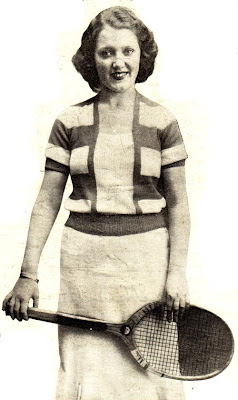 That's a simple lace panel in the center, the rest just plain stockinette stripes. This pattern is crazy though--how can you write a pattern without mentioning the gauge?!--and it was supposedly written to fit a 32" bust (hah!) So I'm basically rewriting the whole thing, adding length (15" before binding off for the armholes instead of 12"), and shortening the sleeves so they'll match the longer stripe pattern on the body. The whole thing's going to be fitted where the original was blousey; I think it'll be more flattering, but the real reason is I'm afraid I'm going to run out of yarn. I bought a few skeins of each color on sale before I knew what I wanted to make. (More detailed notes on my Ravelry project page.)
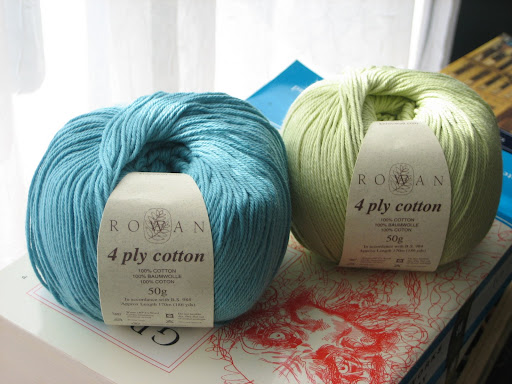 That blue isn't a color I'd normally wear, but I'm trying to do colors other than green, purple, and black. Now I just have to find a tennis racket...
Make Do and Mend
 How exciting is this: I've got an essay in this week's episode of Cast On, which is far and away my favorite podcast! The series theme is 'Make Do and Mend,' taking inspiration from WWII-era booklets on repurposing and economizing. I'm continually inspired by my grandparents' thrifty lifestyle (I've already told you about the candy tin o' buttons), so that's what my essay is about. I know a lot of you reading this aren't knitters, but Brenda's podcast is well worth a listen regardless.I have so many items of clothing ready to be mended or repurposed--the challenge is actually getting down to making the alterations. There's the vintage 100% wool cardi I mention in the essay, which I think will become a button-down vest from A Stitch in Time (a huge, beautifully illustrated book of modernized vintage patterns, which is on my Christmas wish list). There's another purple sweater I got for Kate when I worked at Anthropologie back in college, which is half-felted; I might as well felt it all the way and make a throw pillow out of it. I have a mohair jumper my mom got me at Kilkenny Design when I graduated with my M.A.; it's forest green, a good color for me, but the design itself is none too flattering (why did it take me so long to realize that?!), and someday I want to frog it (mohair...yikes!) and reuse the yarn so it can still remind me of graduation and my mother's generosity. And I have a sweater I got in Dublin in 2001 that has a hole in the elbow; I still love it, it's purple and in perfect condition otherwise, so I need to pick up some matching sock yarn to knit a pair of elbow patches. I have a feeling I'm going to have to visit more than a few yarn shops before I find a color that's close enough.And I have yet another project that's all about the buttons: my mother has a black cotton cardigan with beautiful sparkly ones that she never wears because the garment itself is faded. As it is, those buttons are going to waste. So for Christmas I'm knitting a classic cardigan that will showcase those lovely buttons (it was her idea), and that faded but still serviceable cotton cardi will get a plainer set of buttons (out of the tin) before it's donated to Goodwill. Two sweaters out of one!But add all these makeover sweaters to a huge pile of unfinished sewing and knitting projects, and it's really overwhelming. Right now I really only have one completed 'make do and mend' project to boast of, and it's five or six years old. My favorite jeans had huge holes in the seat, too big to patch, so I decided to make a yoga mat bag out of one of the legs. I cut out a circle for the bottom out of the other leg, used a sparkly purple shoelace for a drawstring, and a rainbow-striped belt for the strap. Now that I've got my mom going to yoga classes, I figure I can use some corduroy scraps to make her a mat bag too. I'll just have to add it to The List.Next entry: vintage sweater #3!
Moldy Oldie: Trash Your Panties!
Awhile back I mentioned this Washington Square News "op/ed" I wrote in the spring of 2000. It was headlined "Trash Your Panties: Going Commando With Camille." Sadly, it was by far the best thing I ever wrote for the paper. Hope you enjoy it.Thirty years ago we burned our bras. We didn't go far enough.I have issues with underpants. They are expensive, unnecessary and often uncomfortable. No one ever seriously considers the possibility that we women could avoid the nearest Victoria's Secret (or K-Mart) altogether in favor of a far more authentic way to live - with perfect freedom.The prospect of going "commando" always makes for a hearty laugh, and it's true that there's no better place for a pair of lacy panties than atop an inebriated frat guy's head. But why do we bother wearing underpants at all? Underwear, if you're in the market for something a little more feminine than a pair of bland white cotton undies, will cost you more money than I consider it to be worth.A girl makes a trip to the lingerie department for one reason and one reason only, whether she admits it or not -- she's looking for the most enticing scrap of something sheer and frilly just in case the opportunity for a certain type of encounter with the opposite sex should arise. In that case, why bother wasting $30 on a pair of underpants that are just going to be ripped off with wild beastly abandon anyway? So what if the joy of unwrapping the present is gone with the panties; we have more important assets to make use of.Not that I'm advocating a panty boycott to make it easier for those crazy boys. It makes absolute sense that female underwear evolved from the chastity belt, the ultimate symbol of feminine oppression. It is for that very reason that we should abstain from wearing panties; such a defiant act would symbolize quite appropriately the social freedom we continue to desire with such fervor.Fetishization of female undergarments is certainly widespread; girls, if you're ever in desperate need of tuition money, you can always sell your panties steeped in that oh-so-attractive "natural aroma" online and make a bundle. (If I weren't so concerned with simple decency, I might advocate ridding yourself of every pair you own by this method; it's certainly more profitable than throwing them out in the trash.) If we were to avoid the wearing of underpants, men would have to find a more productive and meaningful garment to worship. I suggest socks because of their wintry practicality and distance from the danger zone.Reasons of simplicity and freedom aside, we should reject the restrictions imposed upon us by underwear simply because this article of clothing is a constant source of male delight and strange fascination. We still want them to be fascinated, of course -- just not with our panties. Getting rid of them now would force men to hurry a little faster along that evolutionary path. The absence of underwear also makes it easier for the more carnal and filthy-minded among them to get what they want, but I'm not worried. Men like that use newspapers for house-training themselves rather than for reading material, so if this idea catches on, they won't know about it.No more annoying wedgies, no more unsightly panty lines and no more hard-earned money wasted on garments that nobody is ever going to see. (At least that's what your mother thinks.) It's a curious thing that no one ever included the suggestion to "get rid of your underwear" in any of those "Simplify Your Life" books. Spend your money on something more practical, like ice cream, crossword puzzle magazines or itching powder. I'm holding onto my bra though; there's a three-letter word that begins with S and ends with G that scares me too thoroughly to light that match.
Note to Self
"Before publication, and if provided by persons whose judgment you trust, yes, of course criticism helps. But after something is published, all I want to read or hear is praise. Anything less is a bore, and I'll give you fifty dollars if you produced a writer who can honestly say he was ever helped by the prissy carpings and condescensions of reviewers. I don't mean to say that none of the professional critics are worth paying attention to--but few of the good ones review on a regular basis. Most of all, I believe in hardening yourself against opinion. I've had, and continue to receive, my full share of abuse, some of it extremely personal, but it doesn't faze me any more. I can read the most outrageous libel about myself and never skip a pulse-beat. And in this connection there is one piece of advice I strongly urge: Never demean yourself by talking back to a critic, never. Write those letters to the editor in your head, but don't put them on paper."—Truman Capote, from an interview in the Paris Review, 1957.
The Last of Summer
 The Last of Summer (1943) isn't the best-known of Kate O'Brien's novels, and I was quite lucky to find it at Charlie Byrne's a few months back. (I check the Irish lit shelf every time I go in, but I usually find only the novels I've already read.) O'Brien is among the great Irish novelists, though she isn't nearly as well known (in or out of Ireland) as she ought to be.
Raised in Paris by a French mother and an Irish father (both of whom are dead by the time this story takes place), Angèle first comes to Ireland in 1939 with several other actors over on holiday from London. Towards the end of a sunny, sultry August--yes, sometimes in Ireland the weather is really that fine!--Angèle skips out on her companions to visit her father's relations for the first time.
The Kernahan clan is headed by her frosty, magisterial Aunt Hannah (widow of her father's brother Ned), and Angèle is puzzled by Hannah's hot-and-cold reaction to her sudden appearance. She also meets her father's other brother, the bumbling, kind-hearted Uncle Corney; Hannah's cousin-slash-unpaid servant Dotey; and three cousins all about her age--Tom (the mild-mannered, responsible one), Martin (the brooding, cynical academic), and Jo (who is bound for the convent). Despite the weird vibes Hannah is giving off, Angèle becomes quick friends with her cousins, and Martin makes his attraction to her all too clear.
Having studied in Paris, Martin has far more in common with his long-lost cousin than his older brother, who is the quintessential 'mama's boy.' Their father died when Tom was a teenager, and he has managed the farm and served as his mother's most beloved companion ever since. The conversations between manipulative mother and all-too-malleable son leave the reader feeling squirmy, to say the least, and the author's treatment of their Oedipal relationship isn't exactly subtle ("Always she pleased his eyes as no other woman did." Whoa.) When Tom and Angèle announce their engagement after only a few days' acquaintance, naturally Hannah is outraged, but decides to give her blessing while secretly doing her utmost to unravel the attachment. This way Tom will come running back into her arms when the whole thing ends in tears.
Tom and Angèle don't even know each other, but they believe that the magnitude of their infatuation and their essential good natures will triumph over that pesky requirement of a papal dispensation--for being first cousins, and all--as well as the looming specter of another war in Europe, which may very well prevent Angèle from ever seeing her mother's family again. Their attraction makes sense in that Angèle is an orphan looking for a place in the family she's long wondered about, and Tom sees in her all the worldly experience he's been denied through his father's premature death and mother's 'strangling affection' (to use one of my favorite phrases from another Kate O'Brien novel). Without Angèle, Tom will live the rest of his life under his mother's thumb. He believes he needs her, but he'll never understand the real reason why.
In all her novels O'Brien does a marvelous job laying out the tangles of confused thoughts in a character's head, all the fragmentary images and memories and motives, the weird or spiteful thoughts one would never dream of uttering aloud. We are also privy to the interior monologues and personal history of minor characters like Dotey, who is no less fascinating for all her pathetically self-interested scheming, and the 'genially selfish' Dr. O'Byrne, whose daughter Norrie has been in love with Tom since childhood:
Dr. O'Byrne almost nodded his head as he listened to this delicate little speech--so exactly did it tell him what he had already told himself very often about this woman. She's certainly a great fly in the ointment, he reflected now with anxiety. I could hardly choose a worse mother-in-law for my girl. And she's only about fifty, so far as I recall, and she hasn't a thing wrong with her. Superb organic health. Nothing to stop her hanging on in vigour into the nineties. Upon my word, I think Norrie will need the heart of a lion to face it--but sure, that's what the child has! The heart of a lion, and it's set on Tom Kernahan...
And Jo Kernahan, the twenty-one-year-old future nun, is wise beyond her years, surveying the household's growing confusion over Tom and Angèle's proposed union with dispassionate sympathy. Her interior passages are particularly lovely:
And she had visited Sainte Fontaine--and knew that the best part of her soul was waiting for her there, had gone ahead of her to that out-of-date, cold, mediaeval centre of discipline and rigidity and elimination...
This is also the device through which we discover that all three of the Kernahan brothers were in love with Hannah, and that she and Angèle's father (also named Tom...hmm!) were engaged before the elder Tom jilted Hannah (glimpsed her true colors just in time) and ran off to Paris, never to return. Anxious to acquire the wealth and status of the Kernahan name, Hannah accepted Ned's subsequent offer. This tidily explains Hannah's instant hatred of her sensitive, pretty niece, but what's not so tidy (and is all the more satisfying for it) is that Angèle never discovers the real reason behind her father's hasty departure. These stream-of-consciousness passages are too intimate, all too messy, and that's precisely why they're such a delight to read.
I loved The Last of Summer for the same reason I love all Kate O'Brien's novels: the situation is a train wreck waiting to happen. You know early on how it's going to end, but it's so well done you'll never consider putting it down before you've finished it.
Requiem for a Watering Hole
A lot of pubs and restaurants have come and gone since my first trip to Galway back in the spring of 2000. I still mourn my old favorites--the River God Café (sublime food, awesome mermaid mural on the stairwell wall), Bananaphoblacht ("Banana Republic"--they had the best hot chocolate), Camelot (such a romantic wine bar), the Snug (old-school, had just what it said on the tin). Another pub, Taylor's, became a "Gentlemen's Club," turning Lower Dominick Street into the closest thing Galway has to a red-light district (aside from the "gentlemen's club," there are two sex shops, a casino, and a gay bar that hasn't looked open for business in years. Or maybe that's just what they want you to think...)Anyway, I came upon an old matchbox collection from my college days, and I noticed a fair number of the places I got them from are no longer in business. I'm going to be a huge nerd and share them with you: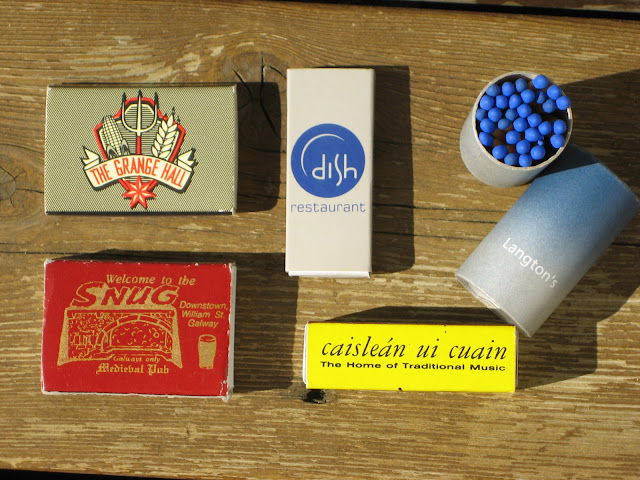 The Grange Hall used to be my favorite café in the Village--it was a really chill speakeasy-style bar/restaurant with wonderful comfort food (best garlic/herbed mashed potatoes ever), a portrait of F.D.R. above the bar, and a huge mural depicting migrant workers on the back wall. I based the local bar-restaurant in Mary Modern, The Dragon Volant, on The Grange Hall.I had my last meal of the spring 2000 trip at Dish, a modern Irish restaurant in the Dublin city center--good food (I think I had a lemon tart for dessert), but not all that memorable otherwise. I'm pretty sure Dish is no more.Langton's (of Kilkenny) is still open, as far as I know--I just included it in the photo because this is the coolest matchbox ever. I ordered a Sex on the Beach there just to scandalize the elderly bartender.And Caisleán ui Cuain in Kilkenny--such a friendly pub! I've remembered the friendliest places, because it was my first solo trip and I was feeling lonesome. It's under new management with a different name now, something so dull I can't remember it.I never got a matchbox from the River God, though I did buy a t-shirt with a mermaid on it (and later lost it at a hostel in Dublin. That was nearly five years ago, and I'm still kicking myself.) I had a delicious lunch there on my own, then dinner with Kate when we visited Galway in '03, and then with a bunch of my M.A. classmates the following year. When Diarmuid's dessert came garnished with a sprig of mint, he cried, "There's a nettle in me ice cream!" Oh, the happy memories.I think somebody should write a guidebook for time-travelers... because if I had the power to travel back in time and 'put right what once went wrong' like Dr. Sam Beckett, naturally I would rather use it to get some really good food at a restaurant that's closed long since.
Screaming Skulls, part 2
(See Screaming Skulls part 1 and the first excerpt from Elliott O'Donnell's Haunted Britain, The Ghost of Anne Boleyn.)
Another screaming skull haunting is associated with Wardley Hall, Lancashire. Roger Downes, the last male representative of his family, was one of the most abandoned courtiers of Charles II. One evening, when out with several of his companions, as rowdy and reckless as himself, he insulted a girl, and on being reprimanded by a tailor, he ran the unfortunate man through the body with his sword, killing him instantly. For this atrocious crime he was brought to trial, but thanks to his social status he was acquitted and allowed to go free, with the result that, instead of reforming, he continued his former abandoned career.Time passed, and then came an evening when his sister and cousin Eleanor were sitting together in a lavishly-furnished room of Wardley Hall. A servant entered with a box, which had come all the way from London. It was addressed to Roger's sister in a queer handwriting she did not recognize. Suspecting nothing, she opened the box and to her horror it contained the bloody head of her brother. On a piece of paper were written these words:"Thy brother has at last paid the penalty for his crimes. The wages of sin are death. Last night passing over London Bridge he engaged in another drunken brawl with the watchmen, one of whom sliced off his head and threw it into the river, whence it was rescued by an eye-witness and sent to thee as a memento."When the sister had recovered from the shock the ghastly spectacle had given her, she had the head buried, but the next day, bearing all the horrible indications of interment and decay, it was back in the house, and every attempt to get rid of it was of no avail. Whenever it was removed such terrible screams resounded through the building during the night that the inmates were frightened to death, and glad to have the head back so as to be able to sleep in peace.When, some time in the 'nineties of the last century, the skull was removed from its habitual resting-place and thoughtlessly put in another spot, albeit in the house, a storm arose in the neighborhood, creating such dreadful havoc that as soon as the cause of it was ascertained (or thought to be), the skull was quickly restored to its former home, when the weather once again became tranquil.Wardley was some years ago, and I believe still is, the property of the Earl of Ellesmere, and according to hearsay the skull even now reposes in its old resting-place in a recess specially made for it on, or near to, a staircase in the hall.How much truth there is in either of the skull hauntings I have mentioned is difficult to say. I imagine they both rest on somewhat slender foundations.
Screaming Skulls, part 1
More creepy stories from Elliott O'Donnell's Haunted Britain (see the first post here):
Screaming skull phenomena are certainly among the strangest of hauntings, and yet they are not uncommon. A particularly sad and tragic story is associated with one in the Lake District.Several centuries ago--exactly how long is apparently not known--there lived in an old farmhouse near Ambleside a much-respected farmer and his wife, Kraster and Dorothy Cook. The little land they owned was coveted by one Myles Phillipson, a wealthy and influential magistrate. On several occasions he asked the Cooks to sell it to him, but they steadily refused on the grounds that it was all they possessed and was, therefore, indispensable.Enraged at being balked in his desire, Phillipson swore he would get the land whether they were alive or dead. Pretending to be very friendly with them, he invited them to a banquet, and during the evening contrived to have a silver cup, which had been purposely placed in front of one of them, while they were dining, put covertly in one of their clothes which had been left in the hall. Pretending that the cup had been stolen by one of the guests, he had everyone searched, and the cup being found secreted in one of the Cooks' belongings, he had Kraster and Dorothy arrested at once. Stealing in those days being a capital offence, Phillipson, before whom they were brought, sentenced them both to death.Directly their doom was pronounced, Dorothy rose in the courtroom, and in tones which rang through the sombre building, pronounced the following curse: "Guard thyself, Myles Phillipson! Thou thinkest thou hast managed grandly, but that tiny lump of land is the dearest a Phillipson has ever bought or stolen, for you will never prosper, neither will your breed."Whatever scheme you undertake will wither in your hand; the side you take will always lose; the time shall come when no Phillipson shall own an inch of land; and while Calgarth walls shall stand we'll haunt it night and day. Never will ye be rid of us."In due course the Cooks were hanged. Some time after their execution, consternation was caused in the Phillipsons' home by the appearance of two ghastly grinning human skulls at the head of a staircase. They were at once taken to a distant spot and buried. That night everyone in the house was awakened by the most blood-curdling screams, and in the morning, to the alarm of the whole household, the skulls were back in their place on the staircase, with even wider grins. And so it happened again and again. Whenever the skulls were removed they came back, and the night of their return the household was appalled by the most unearthly screaming. The skulls were smashed, they were burned, but no matter what was done to them, they recovered and were to be found back in their staircase home, always grinning.In the meanwhile Dorothy's curse was working. Nothing the Phillipsons did ever prospered, they lost all their land and all their money. Their old home, and with it Calgarth, passed into other hands, and what became of them afterwards was never known.
Screaming skulls, part 2 tomorrow!
Another vintage jumper, hooray!

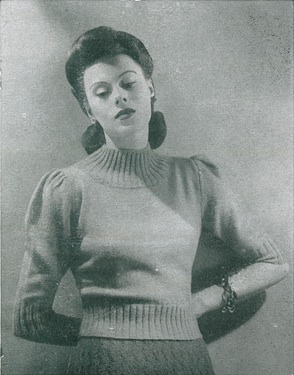
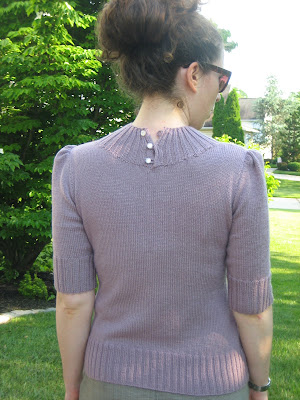
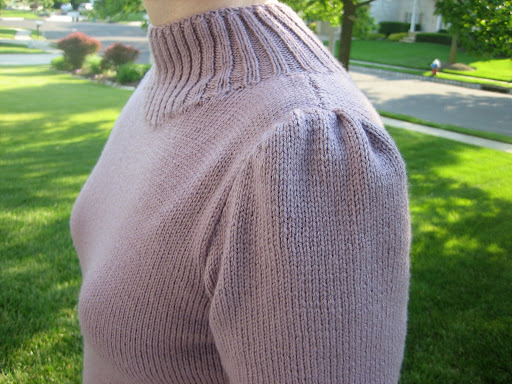
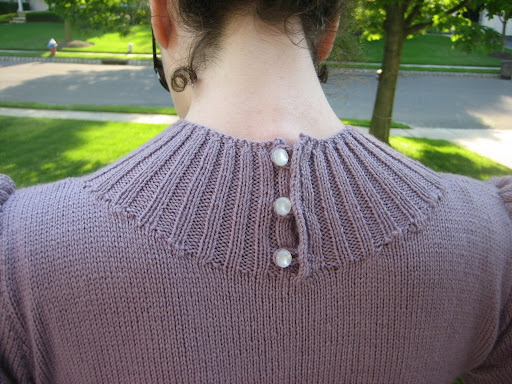
I am really pleased with how this turned out.
Celester on Ravelry kindly passed this WWII-era pattern along (her version is here). Of course I had to cast on many more stitches than called for, and lengthen the body quite a bit (12" before binding off for the armholes? hah!) I used the handy Knitting Daily Waist-Shaping Calculator to figure the decreases and increases. I knit the body in the round with faux seams in garter stitch, and my only regret there is that I worked the waist decreases into the seam stitch. Not a good idea, it looks a bit sloppy, but you'd probably only notice if I drew your attention to it. If I could knit it over again I'd also add back shaping, since there's a little bit of extra fabric back there. I was worried about that as I was knitting the body, but it looks fine. I also bound off at the neck half an inch sooner than the pattern says, using Elizabeth Zimmerman's stretchier sewn bind-off.
Celeste mentioned in her pattern notes that she had a difficult time getting her arms through the sleeves, and when I cast on the 66 stitches called for I realized that was probably why. Cast on 76, increased to 86, and they fit perfectly.
Look at my puffed sleeves! Weeeeeeeeeeeee!
The pattern calls for four buttons to fasten up the neck, and I found just that number of plastic pearl-look buttons in my grandparents' old candy tin (they're probably from the '60s). I later noticed that one of them was broken, so I made do with three. Crocheted the button-loops. Oh, and this yarn is really lovely--I wish I had used it for my Little March Hare jumper, as the quality is better than the Cashcotton (i.e., no little white strands of angora flying up as you knit).
Pattern: here, courtesy of Celeste
Yarn: Rowan RYC Cashsoft 4-ply in Monet, 7 balls
Needles: #2s for the ribbing and #3s for the body
Raveled here.
If I were still in Galway I'd be wearing this every day. Ah well.

Aughnanure Castle

Yesterday I visited Aughnanure Castle ("OCK-na-nure"), a restored tower house (built c. 1500) in a tranquil riverside setting not far from Galway City, and as you can see I couldn't have asked for better weather. (Bats, murder holes, secret chambers...I imagine it might be rather spooky to visit when the weather's not so fine.)
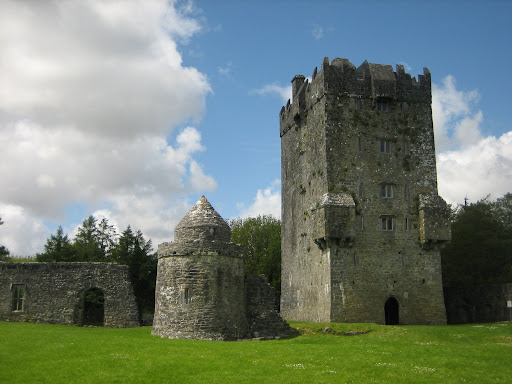 That pepperpot-tower-type thing used to be a watch tower, but most of the wall that connected it to the others is gone (or under grass). Too bad they don't allow picnics here!
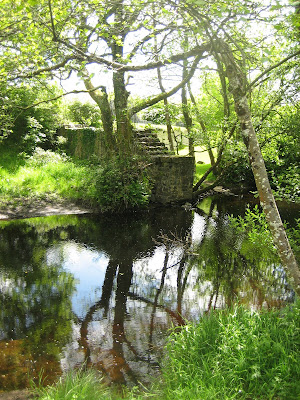
The forty-minute walk from Oughterard is do-able but not ideal, since there are a few spots along the busy N59 without a shoulder to walk on—and Oughterard isn't the most happening spot anyway. Seems there are as many closed (some quasi-derelict) shops and restaurants as there are ones still open for business. If you don't have a car, going by Citylink (as I did) may be your best option. Ask to be dropped off at the castle turn-off, which is about 1.5km before you reach Oughterard. It's a very pleasant 2km (20-minute) walk from there.
(Edit: Alas, it seems Citylink has discontinued this service.)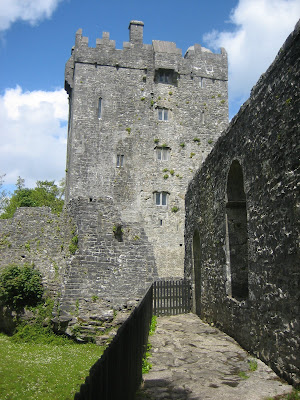
Of Graves and Gardens
I had a lovely time with Seanan's aunt Bríd on my visit to Dublin this week, and had drinks/lunch/coffee with a few more good friends I hadn't seen in awhile. I also wanted to get a bit of sightseeing and picture-taking done (the new edition is still in limbo, but I'm always thinking ahead).My first full day--Mount Jerome Cemetery. Now, I have wandered through plenty of graveyards in my time, but this one really takes the cake on the creep factor. This graveyard is full of crumbling monuments packed so tightly you can't even approach many of them because there's nowhere to walk except on the stones, which I will not do. All of Dublin is dying to get in, you know. (Sorry, I couldn't resist.) There was a funeral going on while I was there. And check this out--not only do I find a Star of David in a Protestant cemetery, but there's a skull inside!:
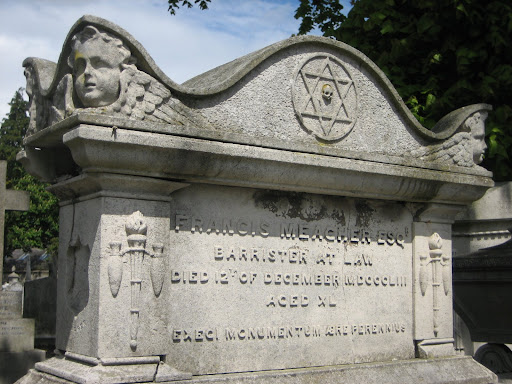 I had wanted to pay a visit to the final resting-place of one of my literary idols--lots of famous Dubliners are buried here--but the place is huge and you can't read many of the inscriptions anymore. I thought I'd stop by the office if I couldn't find it on my own, but I got so creeped-out and sad from my first walk-through that I didn't have the fortitude for a second try. Plus it was about to rain.
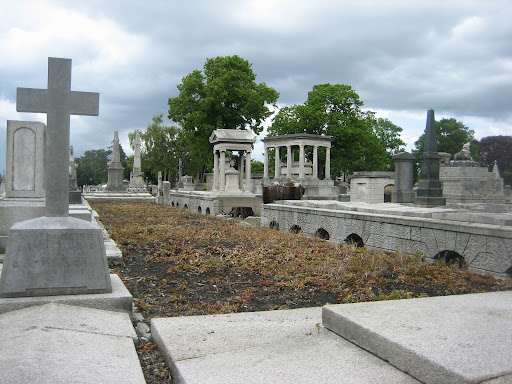 (You walk down to reach those mausolea below ground level. Wasn't feeling brave enough to venture into the open-air corridor to read any of the names.)Second day--the National Botanic Gardens. It was so nice to see (and sniff) so much life after a trip to the world's spookiest graveyard.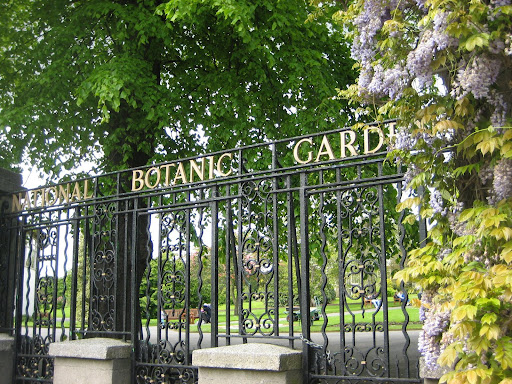

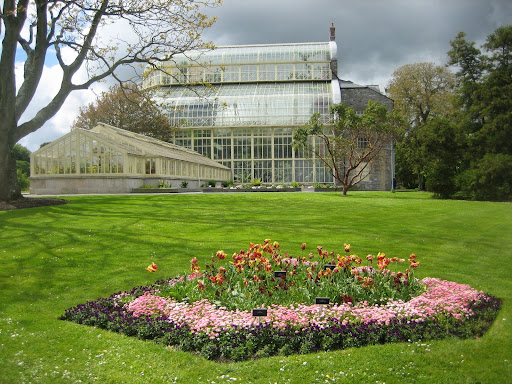 The Botanic Gardens are lovely, and even better, they are free! You can take buses 13, 13A, or 19 north to Glasnevin (fare €1.60), and a guided tour is €2. Definitely worth a visit if you're ready for a change from the hustle and bustle of city sightseeing.Thanks to Diarmuid, I've also got a new lunch spot to recommend--Anderson's in Drumcondra (a ten or fifteen-minute walk from the Botanic Gardens), a first-class creperie. I got the vegetarian breakfast galette and a vanilla latté--scrummy!