Adventures in Berlin, part 1
I flew into Berlin a few days before Kelly did, so that I could do some research-y things in the city before we took the train (er, trains) to the lovely little town of Wernigerode in the Harz mountains (about a 3-hour journey south-west of Berlin). Here are a few more random photos from the first few days...Wernigerode tomorrow!
 Found outside a random flower shop.
 The courtyard outside the German Resistance Memorial Center. It was in this courtyard that Claus von Stauffenberg and others involved in the plot to kill Hitler were summarily executed. (More information on the July 20th plot at Wikipedia.)
And on a much lighter note...
 A giraffe made all of legos at the Sony Center, near Potsdamer Platz.
Back from Berlin
Huzzah! It was a great trip--I got plenty of inspiration for the book, and Kelly and I had a lot of fun. Seanan said he felt like he'd been looking at 'Present at a Hanging' since December, so I think I will treat him (and you) to a blog post full o' pics every day for...well, for awhile. I took hundreds, you know.But for now, here's a random assortment. (I seem to have misplaced my laptop adapter and the battery's running low...)
 The 13th-century Marienkirche against the GDR-era TV Tower.
 Durty graffiti at the East Side Gallery (a 1.3km stretch of the Berlin Wall painted by an international group of artists in 1989-1990).
 (Found on a bridge inside the Tiergarten.)
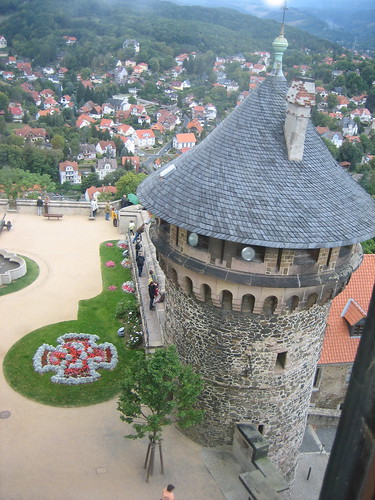 A view from inside the Schloss Wernigerode, in the Harz mountains.
Present at a Hanging
Ghost stories are my (not so guilty) pleasure, as you know, and I'm still sifting through the Librivox catalog looking for old goodies. Right now I'm listening to Present at a Hanging (Gutenberg text here), stories by the American journalist/satirist Ambrose Bierce. So far my favorite is "A Man With Two Lives." These stories are much shorter and sharper than the gothic tales I usually read, and I like that--sometimes a story goes on for thirty or forty pages, and the dénouement isn't as dramatic as all that narrative build-up would suggest. Make sure you read "A Man With Two Lives"--it'll only take you a few minutes.And speaking of Ambrose Bierce: I've been thinking a lot about epigraphs lately, how they flavor and (hopefully) enhance the reader's experience of the story they're about to read, and I thought I would show you the epigraph that opens Petty Magic:
WITCH, n. 1, Any ugly and repulsive old woman, in a wicked league with the devil.2, A beautiful and attractive young woman, in wickedness a league beyond the devil.
More thoughts on epigraphs in a future entry.
Romantic Germany
Lately I've been preoccupied with the new novel and spending QT with the fambly before I head back to Galway (tomorrow, weeeeeee!) Thrift-shopping has become an increasingly frequent family activity, and look what ten-dollar treasure I found at the Moorestown Friends' Thrift Shop yesterday:
 It was originally $20, but all books were half price this weekend, and my mom got it for me as an early birthday present. (Thanks, Ma!)
Just look at the dedication!:
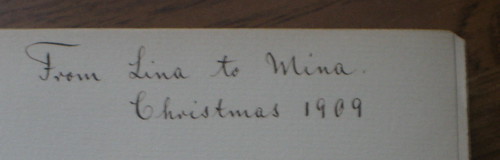
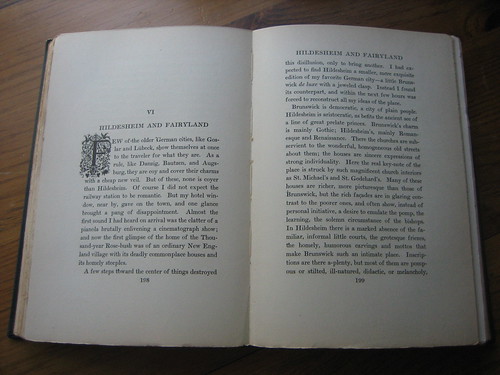
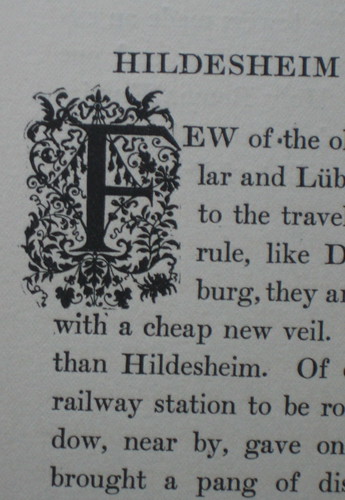 I guess this makes me a bonafide book nerd, but I love when a book has initial letters, the more ornate the better.
I may have neglected to mention that Kelly and I are heading to Germany in mid-September, which is part of why I was attracted to this fascinating old book. We're spending a few days in Berlin and a few days in the Harz mountains, about three hours' train ride west of the capital. The Grimms got most of their fairy tales from the villages of the Harz, and the region is steeped in witchy legends. Peeeeeerfect. One of the highlights will be a trip here.)And here:

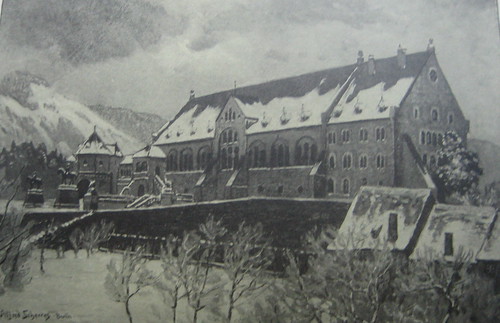 The first castle is in Wernigerode, the second (the Kaiserhaus) in Goslar (2 hours west by train). Funny how I would've most likely overlooked Goslar and all its attractions were it not for this book:
You appreciate the half-timbered dwellings so much that your appetite is whetted for better ones. If you are persistent you find them at the head of the Markt-Strasse. Crescit indulgens! The taste grows upon you. Presently, unless you are very reserved or blasé, you give a cry of pleasure. You have discovered the Brusttuch, a crooked late-Gothic gildhouse named after an indispensible part of the local peasant's costume. It has an amazingly sharp, high ridge. Its lowest story is of picturesque rough stone; its second is half-timbered and filled with such homely, humorous carvings as riot along the streets of Brunswick. Among them are reliefs of convivial monkeys and of witches riding their broomsticks to the Brocken...
I love the florid descriptions in these old books! It'll be interesting to see how much (or little?) the place has changed in 99 years; it's a little eerie reading about these places as yet untouched by the Third Reich and all its horrors. (By the way, the V-2 factory was located in a subterranean factory in the Harz. Parts of it are open to the public, or so I hear, though I think we'd need a car to get there.)Anyway, expect a load of pictures here when I get back to Galway in late September...
The Book of Spies
 "I only regret that I have but one life to lose for my country."Those are the last words of Nathan Hale, possibly the first American spy, seconds before he was hanged by the British in 1776. Hale, a young Yale-educated schoolmaster, was hired by Washington and betrayed by a loyalist relative. The British military official who condemned him to death allowed him to write farewell letters to his mother, sisters, and fiancé, and then tore them up once the noose was put around Hale's neck.Right now I'm reading a wonderful "profusely illustrated" history of espionage, Brian Innes' The Book of Spies, published in 1966. I was reading this book in bed the other night, and (as I tend to do) I fell asleep with the light on. My sister came into my room to turn the light off, and while she was in the room I bolted upright in bed and started...well, 'screaming' isn't the word, they were more like little yelping shrieks. (That wimpy noise was in itself embarrassing--I like to think if there really was an intruder I'd be able to scream properly.) Anyway, I'm pretty sure I was having a dream, a scary dream with spies in it, and for those few seconds before I woke up Kate became part of it.
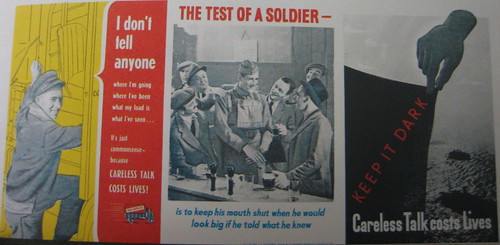 Scared the bejeezus out of my poor mother!
The Mysterious Stranger
My latest Librivox "read" is Mark Twain's "The Mysterious Stranger." Theodore, the young narrator, lives in a small village in Austria in the 16th century. One afternoon while playing in the woods with a few friends, he meets an attractive young man named Satan (nephew of that Satan--angels have family trees too, apparently), who pulls exotic fruits from his pocket, renders himself invisible, makes little men out of clay and animates them, conjures money out of thin air, and performs lots of other tricks for the boys' amusement. In several conversations over the following months, Satan takes pains to tell Theodore and his friends that humanity, to him and his fellow "angels," is as cosmically significant as fleas on an elephant's back. (If that's so, you'd expect he wouldn't bother associating with these base humans at all, but it's all for the sake of the story, right?) His arrival sparks accusations of theft and witchcraft that leave the claustrophobic community in chaos.Anyway, the following passage totally creeped me out:
"There has never been a just one, never an honorable one--on the part of the instigator of the war. I can see a million years ahead, and this rule will never change in so many as half a dozen instances. The loud little handful--as usual--will shout for the war. The pulpit will--warily and cautiously--object--at first; the great, big, dull bulk of the nation will rub its sleepy eyes and try to make out why there should be a war, and will say, earnestly and indignantly, 'It is unjust and dishonorable, and there is no necessity for it.' Then the handful will shout louder. A few fair men on the other side will argue and reason against the war with speech and pen, and at first will have a hearing and be applauded; but it will not last long; those others will outshout them, and presently the anti-war audiences will thin out and lose popularity. Before long you will see this curious thing: the speakers stoned from the platform, and free speech strangled by hordes of furious men who in their secret hearts are still at one with those stoned speakers--as earlier--but do not dare to say so. And now the whole nation--pulpit and all--will take up the war-cry, and shout itself hoarse, and mob any honest man who ventures to open his mouth; and presently such mouths will cease to open. Next the statesmen will invent cheap lies, putting the blame upon the nation that is attacked, and every man will be glad of those conscience-soothing falsities, and will diligently study them, and refuse to examine any refutations of them; and thus he will by and by convince himself that the war is just, and will thank God for the better sleep he enjoys after this process of grotesque self-deception."
A great writer is often a great prophet as well, no?
Ghosts of Mount Holly
 My uncle Dan recently lent me Jan Bastien's Ghosts of Mount Holly, which is the most entertaining book of ghost stories I've read in ages. Mount Holly is the Burlington county seat, a 20-minute drive from where I live in southern New Jersey. Given its rich colonial history, it's not surprising that there are ghost stories attached to the local jail (now a museum, it was designed by Robert Mills, who also designed the Washington Monument), the library (a Georgian mansion), and firehouse (with the oldest continually operating fire company in the country), as well as several restaurants and private homes. There are "Haunted Holly" ghost tours every Friday the 13th, and there's also a Sleepy Holly street party (formerly known as the Witches' Ball) around Halloween-time.The Mount Holly shopping district has undergone a revival in recent years, and a few of these shops are said to be haunted as well. Mill Race Village is a delight--all locally owned stores selling unusual items (stained glass jewelry, quilting supplies, and so forth) in historic buildings. My mom and I have gone shopping here a few times in the last year. One of the most memorable shops is Spirit of Christmas, located in a charming brick house built by Quakers before the Revolutionary War. I've never seen so many Christmas ornaments in all my life (and this is really saying something, considering that my grandmother's collection of snowman effigies easily tops a thousand). It's a sensory overload with all those holiday trimmings crammed into a few smallish ground-floor rooms, so just think how overwhelmed I would have been had I known the building is haunted! Another haunted place is the Robin's Nest, a restaurant and bakery cozily decorated with Victorian paintings and furniture. The food is really good and reasonably priced, and the ghosts usually wait until the place is closed before they start terrorizing the waitresses.True, I love this book partly because I've been to a lot of the places mentioned in it, but it's worth reading even if you have no ties to the area. Many of the stories are seriously spooky, and some are even a bit humorous (like the Hessian soldier who exudes either flatulence or general body odor, the book doesn't specify, and who stomps around in his heavy army boots and tickles the feet of sleeping girls). Actually, one of the creepiest bits of all is the dedication:
I hope the author is referring to beloved pets; otherwise that's pretty darn morbid...
Rabbit Island
From anywhere along the Salthill promenade you can see a rather dramatic headland in the distance to the west (very picturesque at sunset), and I'd been wanting to walk out there for years but never got around to it until recently. This headland is called Rabbit Island because it's an island (though barely) at very high tide; haven't seen any rabbits on it though. Here's a view from the prom, with the Blackrock diving platform in the middle distance:
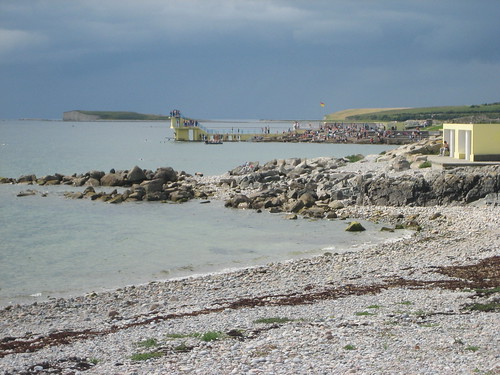 And the next couple photos are on the approach to Rabbit Island. You walk to the end of the prom and then climb over the stone wall into the caravan park, and after that the way is pretty clear.
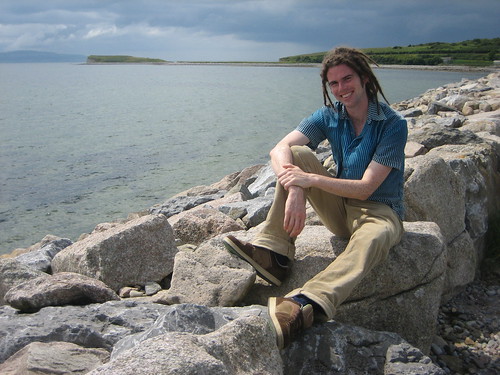
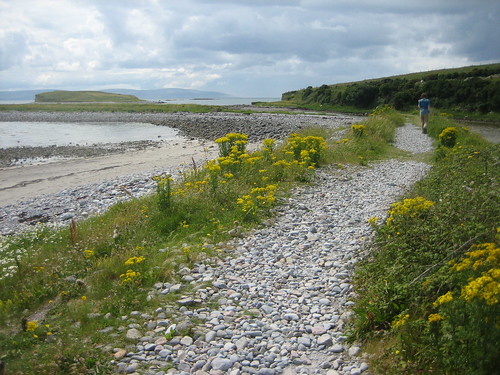 The view from midway up the hill:
 And the view from one of the lookout/make-out spots along the cliff:
 (The second time we came up here, last Saturday, we stumbled upon a couple in an advanced state of deshabille...on her part, at least. Durty, durty. This place is not all that secluded, especially in broad daylight.)
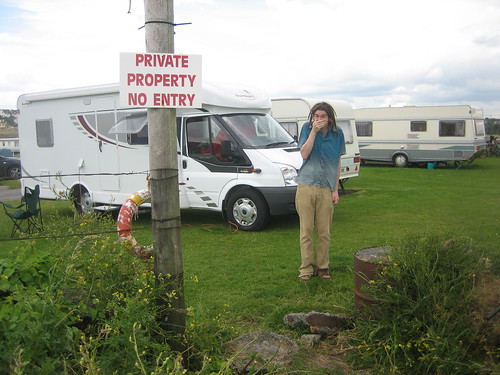 Tee hee!
More scenes from Galway
 I was stalking this swan and her cygnet along the canal for a week or two before I got the opportunity to take this shot, during which time the baby grew quite a bit.
 And here are some flowers for Snookie--hydrangeas are her favorites (sorry, I haven't spotted any blue/purple ones).
Festival Season (reprise)
Sunday night the Macnas parade drew an estimated 70 to 80,000 people. Here's a clip from the website:
A spectacular night time event, "Apocolopolis" is the city that never sleeps, a non-stop party spinning, flashing, beeping and thriving under the agreeable King Du Washawanna and his lovely wife Queen Free. But a sinister threat lurks behind this hall of smoke and mirrors, as the circus comes to town, all pounding drums and flashing flames, led by the terrifying Colonel Chuckle and his hordes of Clownmandos.
It was really fun--felt like the Emerald City on acid, lots of demented clowns and ghouls on stilts and mutant sea creatures busting out of their cages and such. It was hard to get a decent photograph, but here are my best attempts.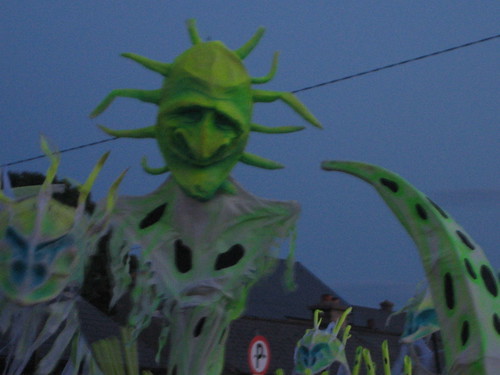 (Felt like this thing was staring at me for about ten minutes before the parade started.)

Nevil Shute
In European History class in high school, we watched an '80s Australian miniseries called A Town Like Alice, based on the novel by Nevil Shute. It's the story of an English girl caught in Malaya during the Japanese invasion, and who is aided by a courageous Australian soldier during the ensuing death march. I loved the film so much I special-ordered the novel from Waldenbooks, though I never got around to reading it.Ten years later I find myself reading WWII-era novels for secondary research--they're very useful for picking up lingo as well as historical tidbits I might not necessarily find in my nonfiction reading--and I've finally delved into the work of Nevil Shute. He was an aeronautical engineer during the war, and he had a highly successful writing career on the side. (For me that's fascinating enough in itself.) His novels are unsentimental yet very moving. His prose is transparent, and I mean that admiringly. The man knew how to tell a yarn. Reading his work makes me sad for two reasons: 1, that it's hard to find a bestseller these days that's anywhere near as well written; and 2, that Shute isn't more widely read today. It looks like all but his most popular novels are now out of print.There's more than one English-Aussie romance in Shute's body of work--I just finished Requiem for a Wren, and while you can tell what happens from the title it was still a page-turner. (By the way, "wren" is a nickname for a member of the Women's Royal Naval Service.) It's the story of wren Janet, who falls in love with Bill, an Australian "frogman," who's killed during a dangerous mission just before D-Day. After the war Bill's brother Alan (an accomplished RAF pilot who only meets her once) becomes increasingly obsessed with finding Janet again.
That day remained etched sharp in my memory; ten years later I still knew exactly how she moved and spoke and thought about things, so that it gave life to all the knowledge I had gleaned about her from these other people.
Janet pretty clearly suffers from post-traumatic stress disorder, and the novel deals with her inability to create a post-war life for herself. She wants very badly to return to naval service because the war had given her a sense of purpose she can't seem to find anywhere else. As Alan (who does the narrating) reflects, "A war can go on killing people for a long time after it's all over." We most often hear the stories of those men and women who survived and built new lives for themselves in the post-war period--because those people, our grandparents and their friends, are still around to tell them--so this novel felt like something of an eye-opener for me.It's also a fascinating look at the life of a trio of service members in the run-up to D-Day. Everyone had their own part to play, but you couldn't talk much about the work you were doing. "Security was so good that neither he nor Bill appreciated the very great importance of the job they had been sent to do." The descriptions of all the tanks and ships amassing for battle is fascinating as well:
At sea, monstrosities of every sort floated in the Solent, long raft-like things proceeding very slowly under their own power, tall spiky things, things like a block of flats afloat upon the startled sea.
Another Shute novel I loved is 1942's Pied Piper, about an elderly Englishman vacationing in the Jura mountains of France who agrees to accompany several small children back to England in the wake of the Nazi invasion. Like Requiem for a Wren (which was published in 1955), the narrative framing device means you know from the get-go that things are going to turn out all right, so it's another testament to Shute's storytelling prowess that you still can't put it down. John Howard, the hero of Pied Piper, is only 69, but Shute portrays him as far more frail than any 69-year-old I've known. He winds up fishing in a remote part of France, intentionally losing touch with the news, because he can't stand sitting around in England feeling impotent. He wants to serve his country in some way, but every application he makes is denied. In Requiem, Janet's 64-year-old father successfully applies for a job as an aircraft identifier in the merchant navy. When Janet remarks on one comrade who looks particularly elderly, her father replies, "He says he's sixty-three. If you don't walk with a stick they don't ask too many questions."And how do children cope with such hideous violence? This is another aspect of war that gets glossed over in the standard history textbooks. John Howard is a tender guardian, doing his best to distract his young charges from the horrors all around them. These kids are so young they don't understand the concept of death yet, so they're very curious. "You mustn't go and look at people when they're dead," he tells them. "They want to be left alone."How did I find these wonderful books if they're out of print? Charlie Byrne's, Galway's best bookshop, has a section of '60s dime-store novels: war, adventure, spies, tear-jerkers, you name it. It's easily overlooked--a narrow bookcase wedged between the Irish literature section and the doorway to the travel/music/film/history room. I've been going to Charlie's for years and I only noticed it a few months ago, on the day I found out we'd sold Petty Magic (so I arrived ready to treat myself). I bought nearly a dozen of these novels for €2-3 each and they've been both entertaining and useful. I love the smell of these old books too.
Thoughts on Anne's 100th
Have you ever found yourself moved by passages in books you've already read multiple times? I've been listening to Anne of the Island on Librivox while knitting, and this paragraph (among others) got me all teary:
Mrs. Rachel Lynde said emphatically after the funeral that Ruby Gillis was the handsomest corpse she ever laid eyes on. Her loveliness, as she lay, white-clad, among the delicate flowers that Anne had placed about her, was remembered and talked of for years in Avonlea. Ruby had always been beautiful; but her beauty had been of the earth, earthy; it had had a certain insolent quality in it, as if it flaunted itself in the beholder's eye; spirit had never shone through it, intellect had never refined it. But death had touched it and consecrated it, bringing out delicate modelings and purity of outline never seen before--doing what life and love and great sorrow and deep womanhood joys might have done for Ruby. Anne, looking down through a mist of tears at her old playfellow, thought she saw the face God had meant Ruby to have, and remembered it so always.
I've lost track of how many times I've read Anne of Green Gables. Looking back on my childhood, I see how crucial the series was in my creative development. In these gloriously sentimental novels, I found a model for my own teenage years—it became important to me to live a "secret life" inside my notebooks and on the canvases I albeit rarely finished. Anne has a lush imaginative life that spills out into the world around her, brightening the lives of everyone she meets.
But as I reread these books as a 27-year-old, I get a certain nagging feeling about Anne's adult choices. There's an Anne appreciation group on Ravelry (all those cozy Victorian cardigans in the films, you know), and someone posted a link to this essay re Anne's 100th anniversary. As Meghan O'Rourke writes, a lot of critics say Anne lets us down when she gives up on a writing career for full-time domesticity, though O'Rourke believes she's still a proto-feminist for all that.
I'm not saying L.M. Montgomery ought to have kept Anne from marrying Gilbert, but why does she have to give up on her writing altogether? In Anne's House of Dreams she spends most of her time baking, sewing, and rejoicing in her pregnancies. There's no mention of Anne sitting down with pen and paper except for letter-writing. There's an opportunity to write the life story of an elderly sailor friend, Captain Jim, but Anne tells herself she isn't up to the task. (A visiting journalist eventually takes on the project, and fame and riches follow the book's publication.)
Meghan O'Rourke writes, "Her physical offspring have to share the house with her fertile imagination." I don't know about that. The last three books in the series focus on the dreams and exploits of her six children, none of whom are anywhere near as interesting as she is. And by the last novel, Rilla of Ingleside, Anne is only ever mentioned in passing.
I suppose the only way to read these later novels is to keep reminding yourself that Anne, like all literature, is a product of her time. As O'Rourke points out, her critics are coming at it with a 21st-century notion of feminine success.
At any rate, it's the first three books I come back to, the stories in which Anne's future is still a bright and shining thing.
Where have all the good husbands gone?
From Anne's House of Dreams, by L.M. Montgomery:
"Don't you know ANY good husbands, Miss Bryant?"
"Oh, yes, lots of them--over yonder," said Miss Cornelia, waving her hand through the open window towards the little graveyard of the church across the harbor.
"But living—going about in the flesh?" persisted Anne.
"Oh, there's a few, just to show that with God all things are possible," acknowledged Miss Cornelia reluctantly. "I don't deny that an odd man here and there, if he's caught young and trained up proper, and if his mother has spanked him well beforehand..."
More on the Anne of Green Gables series in my next post.
Festival Season
July is a great time of year to be in Galway. The Film Fleadh is on right now, and the Arts Festival opens on the 14th. Last night Brendan and I went to Eyre Square to catch a free screening (actually, it was the world premiere) of Kíla: 'Once Upon A Time'. I hadn't heard of them before, though they've been a band for many years--made me wonder if I'd unwittingly been living under a rock. Before it started Brendan described Kíla as "psychadelic trad," which seemed pretty accurate to me. The funkiest part was when women in Rococo-style foufy white wigs and fancy garb were walking around the stage in stilts.I sat on the grass and knit while Brendan danced like he was at a rave, and some loser (bottle of Buckfast in hand, of course) came up to him and asked for drugs. The dreaded bohemians smoking weed in the crowd don't bother me somehow--it's the lads who drink to get drunk, piddling in doorways and generally making total nuisances of themselves, who make me angry. That Brendan might have been dancing out of sheer enjoyment of the music never would have occurred to a guy like that. At any rate, it was really fun for me to sit there and watch him. I wish I'd brought my camera so you could see how happy he was.So we walked through the city centre to get home, and the weekend revelers were out on Shop Street in full force, as usual. Like I said, I have very low tolerance when it comes to public intoxication, but every so often you come upon a truly entertaining drunk. Last night there was an overweight man dancing in the street outside Neachtain's without a shirt on, shimmying up to passersby while singing "Woo hoo, woo hoo hoo" (click here for clarification). And when I say "shimmying up," I mean he was jiggling his man-boobies in random women's faces. This was all mildly amusing, but what really clinched it for me was when one (sober) woman he accosted in this fashion replied (with facetious delight), "What a treat!"Gosh, I love Galway.
Back in Carrick
When we were in Carrick-on-Suir back in March, Brendan took me to a beautiful spot called Millvale a couple miles outside town. The road is winding and wooded, and you hop over a stone wall and come down a steep embankment to find this:
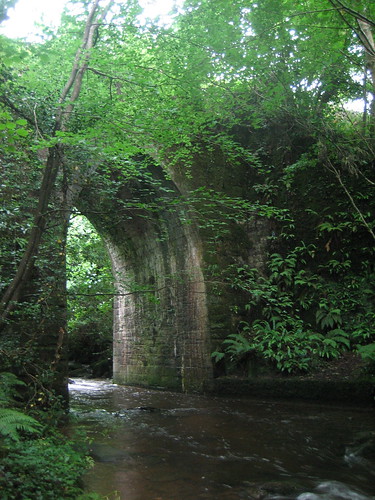
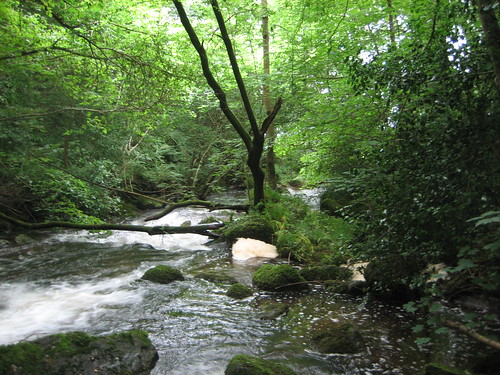 This bridge was destroyed during the Civil War (in 1922 or 1923), and was later reconstructed.
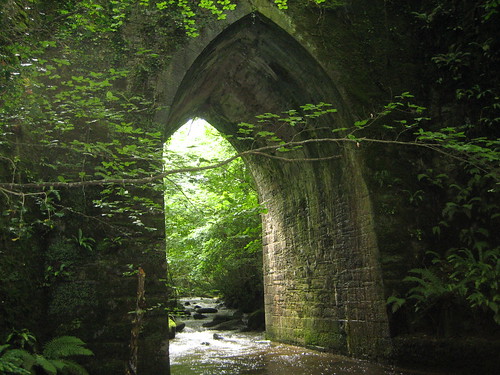 It's so peaceful down here--all you can hear is rushing water, and the occasional car passing up above. There are bits of rubbish amid the undergrowth, even a few rusted car parts, but I think most of it was thrown over the wall. I can't imagine somebody coming down here to listen to the river and the wind in the trees, and then leaving their empty cans behind. We were lucky the weather held as long as it did.
And on our way to Millvale, we found loads of foxglove growing on the side of the road:
 The weather has been cool and very capricious lately--sunny, overcast, and raining buckets all within the span of minutes. Funny how the wildflowers remind you it's actually July.
Apropos of nothing
Yesterday it was a glorious evening, and I went for a walk on one of the little beaches along the prom. Just look what I found written in the sand: Gosh, these American presidential campaigns are kicking off sooner and sooner.
The Paper Mammoth
Have you noticed the "Writers' Rooms" link on the right side of the page? I've been daydreaming about a proper study-slash-studio since I was a teenager, and that weekly feature in the Guardian fuels my reveries. I love looking at other writers' workspaces and reading about why they've chosen a particular location, piece of furniture, or wall decoration, and how each element helps (or hinders) them in their work. In my head I've painted the walls and installed (and filled) the bookcases and chosen the upholstery for the wing-backed chair in the corner, scoured junk shops looking for the perfect big old desk, and finally settled upon the perfect filing system. I'm so nerdy I even want to organize my shelves with the Dewey decimal system (um...no...not even kidding).
Of course—seeing as I live in a rented room, do most of my writing at the library, and have books and notes scattered between three separate domiciles—the only part of this fantasy that is currently relevant is the bit about the filing system. I do a lot of talking about "getting organized." You could say that my chaos must be functional enough if I've managed to produce a few publishable manuscripts out of it, but that's not good enough.
It isn't so much a matter of every book, print-out, and notecard being in its proper place as much as having an effective system for filing ideas. I have lots of notes on receipts and torn bits of notepaper, and I do manage to hold on to most of it, but it's all very inefficient. You can just write every random thought down in a notebook, but then each of those individual ideas are eventually going to need sorting according to their respective projects (in a single notebook I could have notes for the project at hand alongside ideas for future novels and stories, notes on a local restaurant I want to write up for the second edition, lists of books to read, and even sketches of sweater designs I'd like to use as inspiration once I have the skillz to knit it). So how to sort it all while keeping it portable?
At first I thought index cards were the best way to go...but then how would I sort and store them? I've tried recipe boxes with tabs, but that seems to work better for sorting ideas within a single project. And if the idea could be expressed in only a word or two, it seemed a little silly to devote a full-sized index card to it. I also started using Stickies as virtual index cards, but then my hard drive crashed and I lost it all. (Incidentally, the Mary Modern folder was the only thing the tech guy was able to retrieve. KISMET!)
Then I had the idea to sort all ideas:

I had asked my dad for a Rolodex a couple Christmases ago, but then I realized I'm too nomadic and didn't know enough people to bother actually using it (and yes, the address book on my iBook dock makes a Rolly pretty much obsolete, but see previous paragraph for why I don't use it much.) I've got tabs for words and phrases, witticisms ("If you had a penis you'd understand" —guess who), witchy business, WWII flashbacks, and so forth, and another tab for everything that isn't Petty Magic. That stuff can be sorted later. So far it's working out pretty well. The only annoying thing is that Rolly cards are actually rather expensive, and I need to find a hard case for when I travel with it.
I know: I'm a total nerd. A pedant, even. Call me what you like, so long as I can keep it all straight.
Moon Ireland photo essay on Amazon.com!
Thanks to the Moon Handbooks marketing gurus, there's now an Amazon.com "storefront" with photo essays from lots of Moon authors, including yours truly.This feature "went live" a month and a half ago, but after the initial rush of excitement I completely forgot to blog about it. Most of the photos were already on the gallery page of my website, but it's still pretty cool to see them on Amazon!
Mary Modern now out in paperback!
 I almost wet myself with excitement the day my editor emailed me the new paperback cover. Isn't it incredible? The über-talented Dan Rembert designed both covers, but he really outdid himself with the re-design. You can't see it too well in the jpeg, but those faint horizontal lines are DNA code. Captures the quirky spirit of the book just perfectly.At the back of the book you'll find a reading group guide as well as an author essay written especially for the paperback edition. I wrote about how my great-grandparents' engagement portrait sparked the idea.Hard to believe it's been a year since the novel came out. I'm trying not to think about how well the paperback will end up selling, and actually, it isn't all that hard when my head is so full of plot lines and bits of dialogue from Petty Magic...
Inishbofin
Brendan and I just got back from two nights on Inishbofin, a small (6km long by 3.5km wide) island a half-hour ferry ride off the coast of Connemara (not far from Clifden).
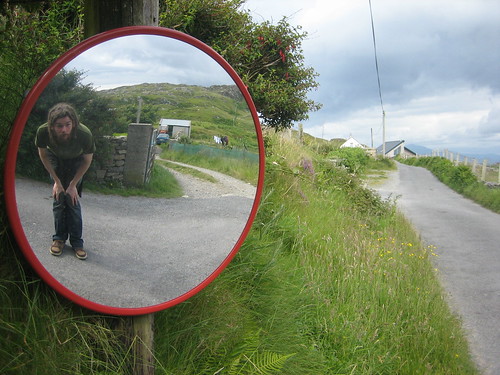 There isn't really anything in the way of tourist attractions, so Inishbofin doesn't see as many visitors as, say, Inis Mór (the largest Aran island). We came hoping for long peaceful walks and a bit of swimming, and we got both.
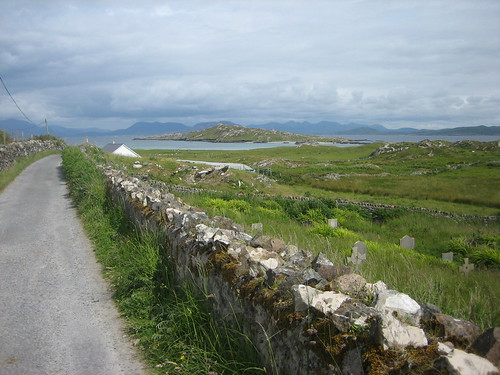 Above: the main road out to "East End Village," with a view of little Inis Laighean (uninhabited except by birds and occasionally sheep, which are brought over by boat) and the Twelve Bens of Connemara in the distance.
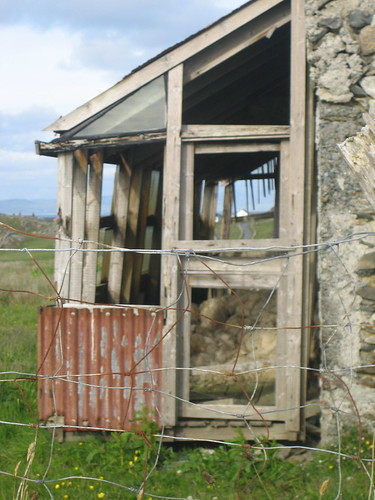 On our Monday evening walk to the northern shore, we passed this shed full of fleeces. There are plenty of sheep on the island, many of which had been sheared recently.
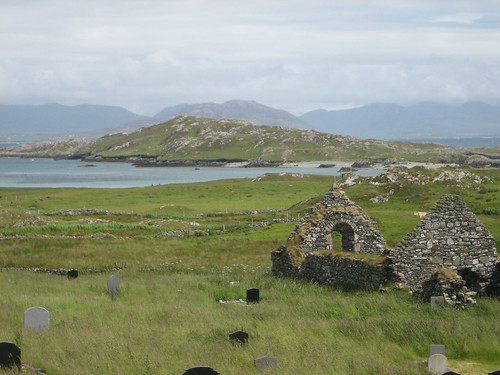 Inis Laighean again, with a view over the island's graveyard and the ruins of St. Colman's Abbey.
 A closer view of Inis Laighean. On Tuesday morning we swam out to it, over a lot of long hair-like seaweed that got tangled around our limbs until we started swimming on our backs. It was a little creepy, that sensation of slender slippery vines winding around my neck and arms. The water was only waist-deep at most though. We got to the far shore and frolicked over much of the island. I never thought I would be walking barefoot on sheep turds in a wet bathing suit and telling you it was one of the most glorious things I've ever done, but here you have it. It was so exhilarating. The weather changed every few minutes--sometimes it was warm and sunny and then the clouds would gather and it would drizzle a bit. The island itself was interesting too--hilly and rocky and covered in strange squishy mosses and heather and tiny wildflowers.Later that day, when we had lunch at this great little café nearby (called The Galley), we told the owner we'd swum out to it and she seemed pretty horrified. She told us we were crazy. We had just assumed loads of people swam out to it, but she said she hadn't ever heard of anyone swimming it, only walking out at low tide (when there was no water at all) and then getting stranded on the far side. She showed us how to get to the ruins of Cromwell's barracks, on an island overlooking the harbor, but when we got to the place where we were meant to take off our shoes and socks and wade across, the water was too deep (we weren't wearing our bathing suits anymore, otherwise we'd have done it). Here's a view of Port Island, where the barracks are--see those three little mounds on the horizon line?
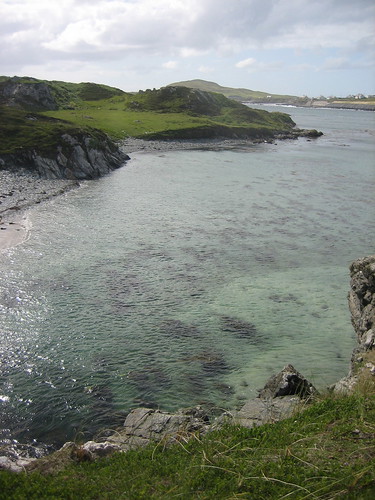 Anyway, if you ever go to Inishbofin, swim out to Inis Laighean and romp around a bit. The views are amazing, and if you don't like the idea of tramping on sheep poo in your bare feet you can always pack a pair of water shoes.