Great Book #86: Uncle Tom's Cabin
 Julie at Forgotten Classics has recently finished her reading of Uncle Tom's Cabin, that seminal novel by Harriet Beecher Stowe. Legend has it that upon meeting Mrs. Stowe, President Lincoln exclaimed, "So this is the little lady who made this big war!"Stowe's characters--the Christ figures of Uncle Tom and little Eva; runaways Eliza and George, Cassie and Emmeline; and everyone Tom encounters as he suffers through a succession of owners--illustrate in all-too- human terms what Condi Rice has called our country's congenital defect (and no doubt that's the only thing Dr. Rice has ever said that I can agree with!) The novel doesn't merely demonize the slaveholders (that would be too easy, and anyway not all of them are depicted as such; some are weak men with good intentions). Stowe emphasizes that just because Northerners didn't own slaves didn't mean their consciences were unstained by the evil.Anyway, if you enjoy audiobooks, you should definitely listen to Julie's podcast in lieu of reading Uncle Tom in book form, since she provides so much insightful commentary in addition. I just love the reader's note, with which she begins each set of chapters:
Harriet Beecher Stowe wrote Uncle Tom's Cabin to expose the inhumanity of treating human beings as things. Former slaves agreed that her examples were true to life. Thus, some of the language and attitudes in this book are offensive because they reflect an ugly history. It is said that those who forget history are doomed to repeat it. The reader does not wish to be responsible for dooming anyone by censoring either history or literature. Therefore the book will be read as it is written, offensive language and all.
Julie's reading sometimes brought me to tears, but I don't feel the urge to write a long post on this book. It's an important work-- melodrama and all--and everyone (American or not) should read it at some point.
Emily capelet!
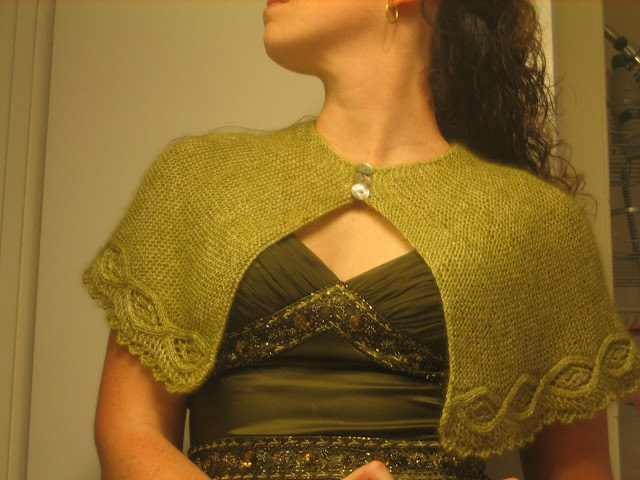 Sorry, but I have to gush a little: I fell in love with this capelet as soon as I saw Ysolda tweeting about it. It's so elegant and neo-Victorian, and the attention to detail is really fantastic--the short-row shaping, the intricate cable and scalloped lace, the built-in i-cord edging around the neck. Knitted it to go with this awesome green dress, which I'm wearing to two weddings this year. I was hoping for better pictures, but the weather's been terrible lately, so I just snapped these before I headed off to Jenny and Greg's wedding tonight.
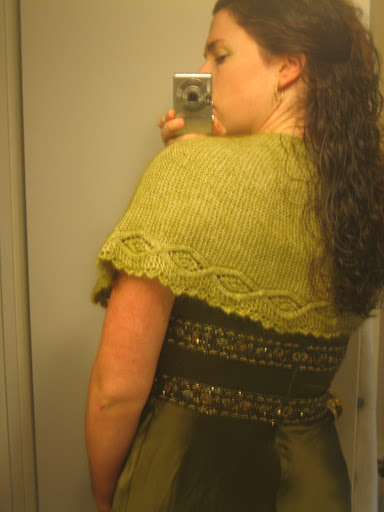 The pattern calls for 'heavy fingering to light worsted' and Chiara is a DK weight (perfect, you would think), but my gauge was too fine, so I cast on 68 stitches (instead of 52) to get the same length (13"). The yarn is marvelously soft and fuzzy (it sheds a lot, but that's okay), but I still can't figure out what color it is. It was a pale green (so I thought) when I bought it, but as soon as I got it out of the shop and took a ball out of the bag to fondle it again in natural light, it seemed gold, not green at all. Fortunately there's some bronze-ish beading on the bodice of this dress, so it's complementary no matter which color it is.And I happened to have three adorable little buttons left over from Mamacita's 2008 Christmas present, so it's even a bit of a make-do-and-mend.
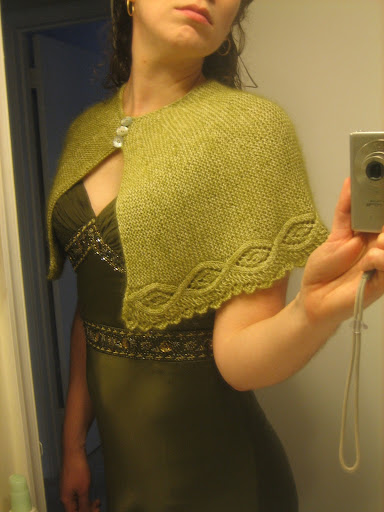 I was chatting to Jenny's friend Brenda at the wedding, and she said I looked like a character out of a Brontë novel. I love it!
Apple-Picking
Last weekend I went apple-picking with Angela, Matt, Kelly and Jeff at the Warwick Valley Winery.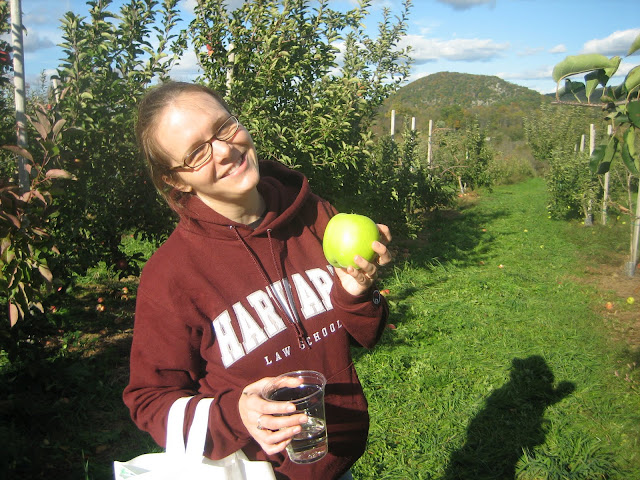 We got cider (I had raspberry, yum!) and took our cups into the orchard for some one-handed picking. (Kelly also picked up a bottle of pear liqueur, which unfortunately tasted like turpentine, or maybe rubbing alcohol. However we described it at the time was very hilarious to me, but unfortunately I can't remember what it was. A couple pints of cider makes one very merry, but rather forgetful.)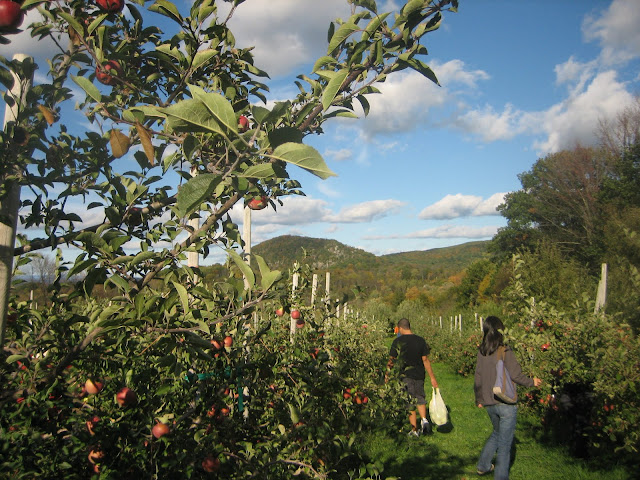
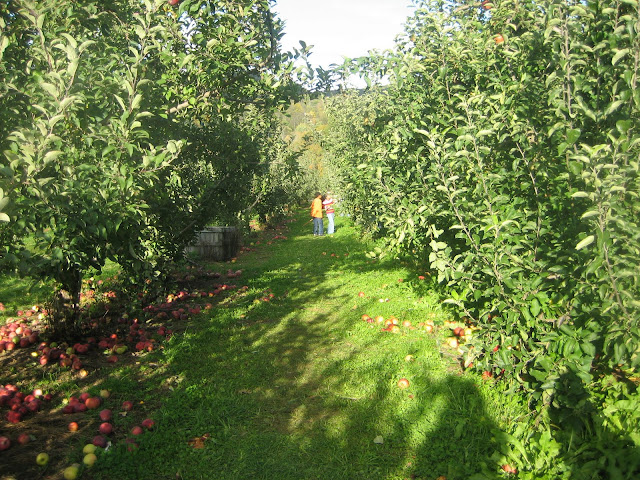 We spent the night at Matt's family cabin in Highland Lakes in Sussex County, which is an absolutely gorgeous part of New Jersey-- especially with all the fall foliage--and Kelly was finally forced to stop calling it "Dirty Jerz." Bwahahaha!
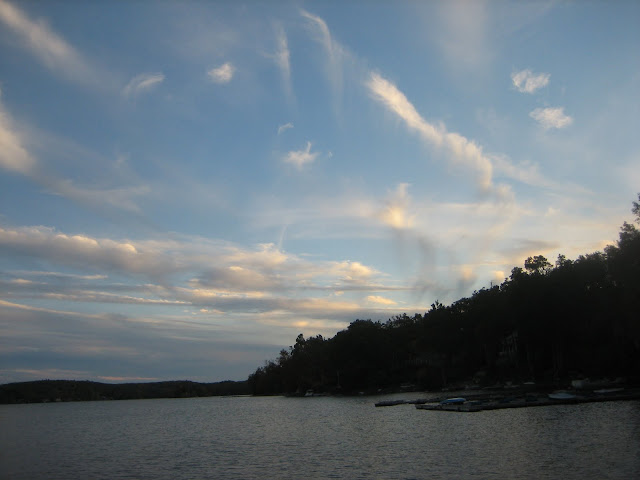 We got to the cabin late in the afternoon, and went for a walk by the lake.
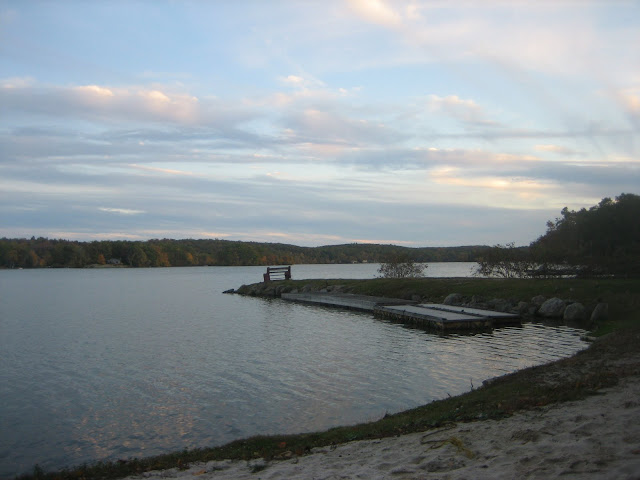 There was a wedding going on in the clubhouse, and we considered crashing it, but contented ourselves with frolicking on the tiny beach: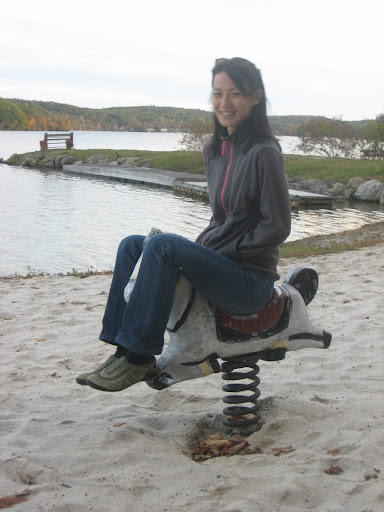
 (What a ham.)
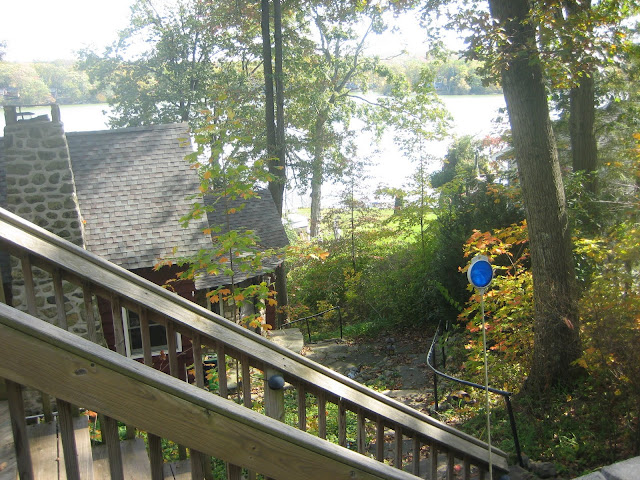 (The view from the road.)Things I neglected to take pictures of: inside the oh-so-cozy cabin, with an old wood-burning stove; apple pie and apple turnovers; rock-climbing in Montclair on Sunday afternoon (or attempted rock-climbing, in my case. I wimped out of climbing and only rappelled down, while Kelly kicked butt both up and down, and Matt and Angela of course made it look easy-peasy.)One more awesome thing: Matt's grandmother's collection of owl figurines.
Love only what you do, and make.
When I applied to Yaddo a few months ago, I wasn't thinking too much about my chances. It was something proactive at a time when I needed to be thinking about the future, so I felt good just dropping the application in the mail. As the day of judgment approached, though, I half-convinced myself I couldn't get in, despite the warm encouragement of Jonathan Santlofer (former Yaddo board member, artist, author, and all-around awesome guy).But I did get in! I got the letter on Friday. This is a tremendous honor and opportunity, and I intend to suck the marrow out of the whole experience. So many 20th-century American heavyweights have stayed at Yaddo--Truman Capote, Langston Hughes, Eudora Welty, Flannery O'Connor, John Cheever, Sylvia Plath, Ted Hughes, and on and on--it's very humbling, to think of them.Of that list of luminaries, Sylvia Plath's is the name that resonates most with me, though I feel a little guilty admitting it. Not that she wasn't a brilliant poet, but her work is the stuff you live on when you're nineteen and hopelessly misunderstood (or such is your belief at the time). I picked up a copy of The Unabridged Journals when I was in college, and naturally I had to go back and read the entries she wrote at Yaddo in the fall of 1959. She sketches ornate old furniture and wall sconces, describing photographs and engravings in minute detail, and frequently doubts the quality and importance of her work:
I feel a helplessness when I think of my writing being nothing, coming to nothing: for I have no other job - - - not teaching, not publishing. And a guilt grows in me to have all my time my own. I want to store money like a squirrel stores nuts. Yet what would money do. We have elegant dinners here: sweetbreads, sausages, bacon and mushrooms; ham and mealy orange sweet potatoes; chicken and garden beans. I walked in the vegetable garden, beans hanging on the bushes, squash, yellow and orange, fattening in the dapple of leaves, corn, grapes purpling on the vine, parsley, rhubarb. And wondered where the solid, confident purposeful days of my youth vanished. How shall I come into the right, rich full-fruited world of middle-age. Unless I work. And get rid of the accusing, never-satisfied gods who surround me like a crown of thorns. Forget myself, myself. Become a vehicle of the world, a tongue, a voice. Abandon my ego.
Try a first-person story and forget John Updike and Nadine Gordimer. Forget the results, the markets. Love only what you do, and make. Learn German. Don't let indolence, the forerunner of death, take over. Enough has happened, enough people entered your life, to make stories, many stories, even a book. So let them onto the page and let them work out their destinies.A 27-year-old acclaimed poet, bemoaning her wasted youth! (Also, of course, ridiculously ironic given the manner in which she died.) But I love what she's getting at in the second paragraph: it isn't about you, it's about the story. You have nothing to prove, and everything to tell.
Susie Modern
 I finished this beret at the end of August, but since it was my mother's birthday gift I had to hold off blogging it. This is one of the most popular hat patterns on Ravelry, and you can see why--it's so lovely! (I will confess, though, that I still haven't learned to knit two-handed. I make an attempt, it's inevitably awkward, and I get impatient and keep going with my incredibly inefficient one-handed method. I'm afraid that's why the colorwork isn't quite as crisp as it could be. Oh well, next time...)Pattern: Selbu Modern by Kate Gagnon OsbornYarn: Rowan Scottish Tweed 4-ply, thistle (1.2 balls or thereabouts), and Jamieson's Shetland Spindrift, hyacinth (less than 1 ball). I had a ball and a half of the Scottish Tweed left over from the dotty tweed pullover I made last year, so that worked out perfectly.Needles: #1.5s for the ribbing and #3s for the rest.Raveled here.Just look at how cute she is!!!!!
 Happy (week after your) Birthday, Mamacita!
Newes from the Dead
 Mary Hooper's excellent YA novel Newes from the Dead is based on the true story of Anne Green, a 22-year-old servant seduced by her employer's grandson and unjustly hanged for infanticide in December 1650. Anne lies in her coffin--paralyzed, not dead--and thinks over the choices that led to her tragic fate (supposing herself in purgatory), as a team of Oxford physicians prepare for her dissection. The two narratives converge quite elegantly, as Anne is restored to life and hailed as a miracle of divine justice.The historical detail is vivid and often horrifying, but I kept thinking as I was reading that Anne speaks more like a Victorian lady than a 17th-century illiterate drudge. In all fairness though, if Mary Hooper had written a more 'authentic' narrative, most readers would have found it pretty much impossible to get through. Anne's naiveté and weakness of character are the very things that lead to her near-demise--she forsakes her sweetheart, John Taylor, because she believes Geoffrey Reade (an out-and-out scoundrel) when he promises to make her lady of the house someday. She suffers appallingly for her foolishness and inability to protect herself and her unborn child; but then comes her redemption, and the reader is left with the definite sense that Anne will live her life quite differently from now on.Here's my favorite passage, in which Anne recounts her last moments on the scaffold:
...my eyes alighted on John Taylor, and for a brief moment my heart again leaped with joy, for his face was neither accusing nor vengeful but was filled with compassion. This gave me some small peace, for it told me that he'd forgiven me and that, at some passing time, he had even loved me. I smiled at him, though my head was swimming and I felt as if I was in a strange daydream, for 'twas the most curious thing to think that in a short moment I would cease to exist.
Beside the gibbet stood the hangman, wearing heavy clothes and a blanket against the weather, also a leather facemask so that he would not be recognized after. He was big and burly, looking very like the bogeyman that your ma tells you will come after you if you sin. And so he had.Those last two lines give me willies! It never occurred to me that a hangman wore a mask so he wouldn't be harassed in the street afterward; I always assumed it was because hangmen were sadists and so wanted to look as demonic as possible.
Greece retroblog, part 2
(Greece retroblog, part 1.)This post is rated PG-13. You might want to skip this one, Ma.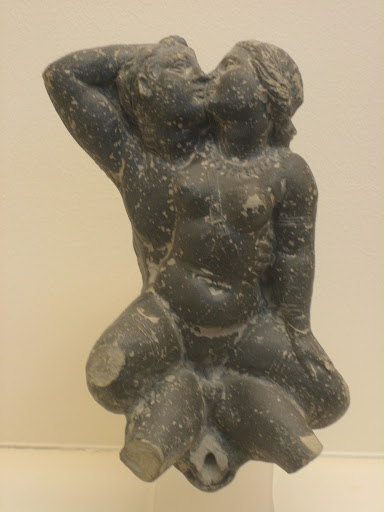 (See?)There were cases full of such durty sculptures at the Delos archaeological museum. Delos, home of the Athenian treasury once upon a time (and equally renowned for its orgies--see above), is an uninhabited island, which is why we stayed two nights on Mykonos (party central, jacked-up prices for the tourists). The food was mediocre and most of the folks we met were entirely too old to be dancing on tables, but as you can see, we made the best of it:
 Minster salsas with a crazy Albanian who was bartending at this place right on the beach.(Speaking of Greek food: apart from Mykonos, we would get the most amazing vegetarian meals everywhere we went--stuffed peppers, dolmades, flavorful baked veggie dishes, and/or fresh salads with lots of feta, and baklava for dessert--plus a carafe of white wine for like €20 total. We had retsina and the most amazing 'zucchini flowers' on a balcony at Betty's at Mithymna, Lesbos...so many memorable meals!)And now for something completely different:
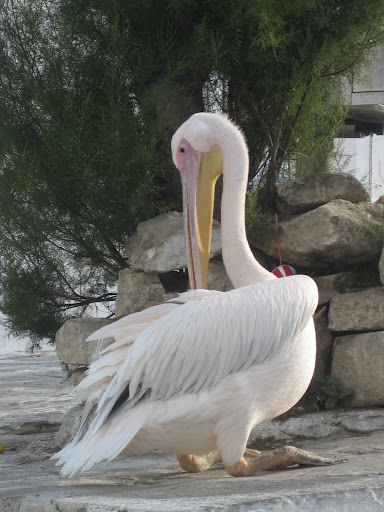 Poor gawky pelican wandering the streets of Mykonos picking at the rubbish.
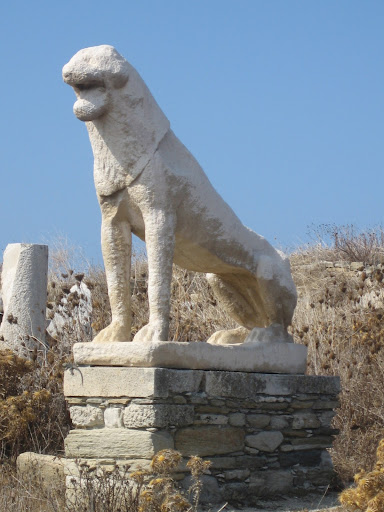 One of the Naxian lions (the originals are on display inside the museum at Delos).Then we took the ferry to Santorini for fun outdoorsy stuff, scuba-diving and riding an ATV all up and down the island.
 We stayed at this awesome domatia at Perissa for €35 a night (for both of us). Went swimming in the pool every morning. Great idea to visit Santorini toward the end of the season!1:25PM -- 2 October 2006 -- Monday, Perissa Beach...Our diving excursion off the west coast of Santorini turned out to be one of the coolest, most worthwhile things I've ever done...[skipping over the complaints about the sketchy diving company]...but once we were on the boat, speeding past all these breathtaking cliffs formed by the volcano, I felt really happy and peaceful--and that feeling only increased when we went under the water. This flamboyant middle-aged guy from New York told us it felt like returning to the womb--it did!--and another really kind and friendly guy from Long Island said he figured that space and sea were the only frontiers left, and since most of us will never board a rocket ship we might as well explore the bottom of the ocean. He was clearly addicted--they all were...
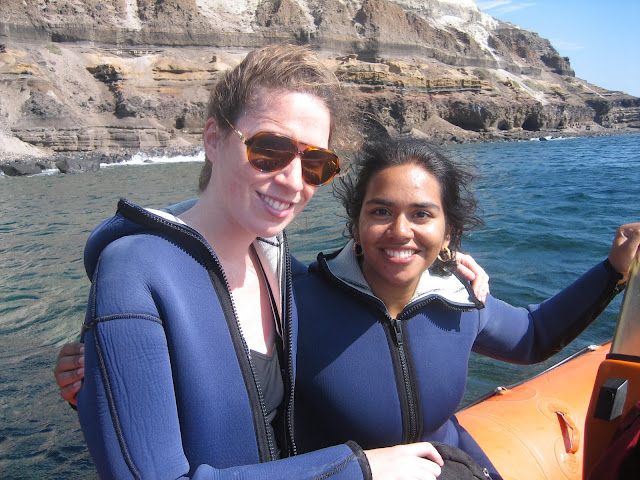 Our instructor would lead us to different places and point out the fish and sponges and suchlike--he even cut open an anemone (with a knife in a sheath strapped to his ankle) and fed a few fish with it. Saw a red-and-white 'poisonous fireworm' too. Sounds cliched to say it was profoundly peaceful on the ocean floor--not that we went all that deep--but how else can I say it? You could look up at the surface and watch your own breath-bubbles rising, shimmering like mercury beads in the light. The second dive was more fun--we were down about seven minutes longer and swam through an underwater cave--the walls were covered in electric blue and orange algae, and to swim around a corner and find the daylight shining through an elegant crevass--oh, it was bliss.I am sorry to say that the ferry passage to Crete was not at all blissful. Yes, that's right. I lost my lunch.
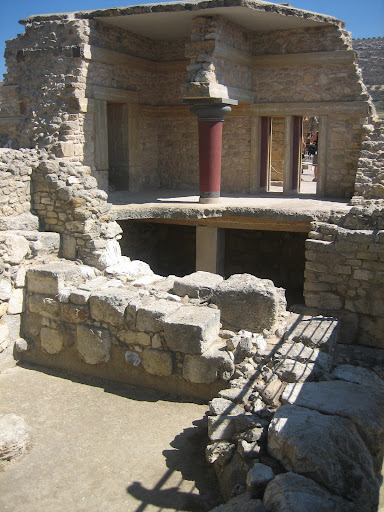 The Minoan palace ruins at Knossos, Crete, which were much more touristy than we were expecting. Many scholars take issue with the restorations executed by the archaeologist Sir Arthur Evans: Coach tours are offered to Knossos, the disneyland of archeology, where Evans poured concrete to recreate his ideas of what this fine civilisation meant (from this site, which has some interesting info despite a few small bloopers...Evans discovered the site at the turn of the 21st century? Really?) Sir Arthur should have left the ruins just as he'd dug them up instead of reconstructing them based on his own imagination. Anyway, I hope this explains the following exchange:
Min: Sir Arthur Evans, the no-talent ass clown. I f****n' hate that guy.Me: Would you like to exhume him and pee through his eye sockets?
The day I became a writer
It was May 1, 1996. My 9th-grade English teacher, Mrs. Gaffney, was out sick, and the substitute brought us to the library and told us our assignment was to pick one of the prints on the walls above the bookcases and write a story about it. It was busy work, but an easy 20 out of 20. I chose a picture of an old farmhouse at dusk, and decided to write a story about a girl listening to her grandmother telling stories on a porch in the twilight--the time of day being, of course, a metaphor as light as an anvil.At the time my grandmother was very, very sick, but I wasn't thinking much about her as I wrote. This was fiction. Where my narrator's grandma told fanciful stories that made her granddaughter doubt if she was 'all there,' mine was still living very much in the present--and was as reluctant as ever to tell any stories about her life. Why did I write that stupid story instead of actually calling my grandmother to tell her I loved her? It was the last night I'd ever have the chance to do it.But I didn't. I printed the two-page story, tucked it in my notebook, and turned it in to Mrs. Gaffney the following day. And that afternoon, on May 2nd, my grandmother passed away.A few days later--I can't remember if it was before or after the funeral, which was on May 5th--my teacher passed back our graded writing assignments. I had forgotten all about it, of course, but I felt sick when I remembered what I'd written. The horrible irony of it!But as if that wasn't bad enough, there was a secondary indignity that pretty much lit the fire under me: Mrs. Gaffney had given me an 18 out of 20. An A-. Mind you, this was the type of assignment we always got 20 out of 20 on. And mind you, I wouldn't have cared if this had been any other day, or any other assignment. I went up to her after class and asked her why she'd given me a lower grade, and she said something to the effect of creative writing being subjectively graded (looking at the print-out right now, it occurs to me that it might have had something to do with the obnoxious font I used). Anyway, I don't think I told Mrs. G. the real reason why I was so upset (there were a ton of overachievers at Mo-town, so complaining about A-minuses happened all the time), but when I got home that night I opened a new word processing document and typed, "I'm going to show Mrs. Gaffney! I'm going to be a writer."And I did show Mrs. Gaffney, who hightailed it home from her golf tournament one day in July 2007 to hear me read from Mary Modern at the local Barnes & Noble. I've never told her what a big part she played in making me a storyteller, but there it is.
Minnie & Mealey's Greek Adventure (part 1)
Traveling with my friend Aravinda (a.k.a. Min) is never, ever dull. We traveled around Greece for three weeks in September 2006, island-hopping on and off the tourist track. My journals from that trip are full of what Min and Leah call the 'liturgy'--a string of inside jokes and assorted nonsense, which we would sometimes recite out loud and add to each time. Here is but a brief sample:
HOT CHOCOLATE + COINTREAU = SEXUAL BLISS. [Written at charming cocktail bar on Lesbos.] This music is making me sterile. "Oedipa came to, to find herself getting laid." "She's sniffing his armpit. He's dry-humping her. That's real sexy." [I believe that refers to a pair of turtles we found tussling in a cemetery.]
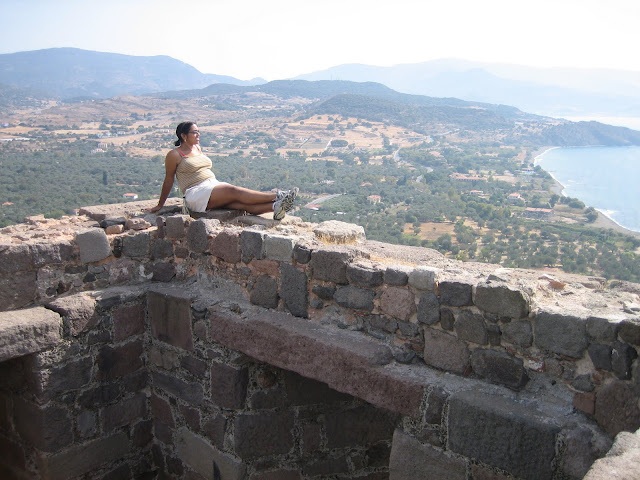
A walk through olive groves outside Plomari on Lesbos: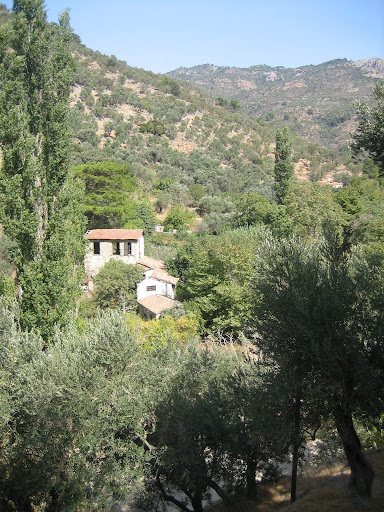 Minnie Minster chillin' on the ramparts of an amazing medieval fortress, Mithymna, Lesbos:
 We went to a hot spring near Mithymna as well, in a small building that reminded me of an igloo (hah!) You would hang out in the hot water for awhile (trying to avoid looking at everyone else's boobs--we were the only women there in one-piece bathing suits), then go straight outside and dive into the sea. So refreshing, I can't even tell you.

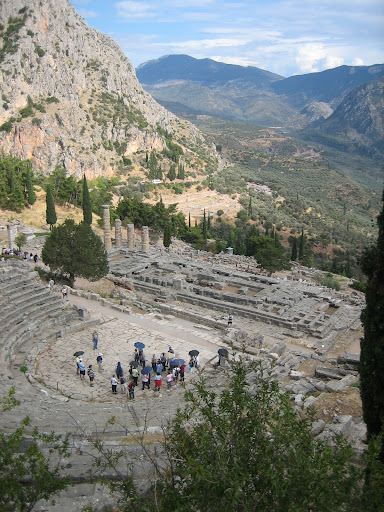
Pretty much the only places we visited on mainland Greece were Athens and Delphi. The Acropolis is as touristy as you'd expect, but I found it funny that once you're up there, you look down at the city and you realize just how hideous all the modern architecture is. The only good view is looking up at it. Delphi was almost as touristy, but the scenery was fantastic.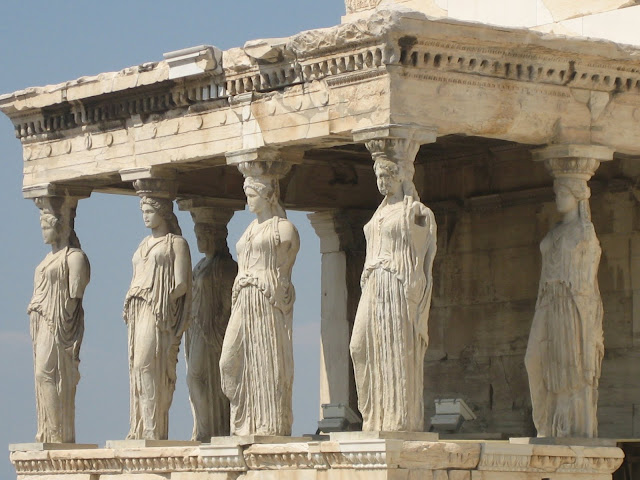 (Above: the Erechtheion on the Acropolis; below, Delphi.)
 We visited six islands in all: Lesbos, Ithaki, Mykonos, Delos, Santorini, and Crete. We'd originally wanted to visit the Peloponnese, but realized we didn't have quite enough time, and Ithaki was plan B.9:30PM--Friday, 22 September 2006Ithaki is lovely. Min says it's her new favorite, but I can't decide which place I prefer. This afternoon we walked a couple kilometers past darling terraced houses and hills covered in olive trees to a small secluded harbor and pebbly beach. The water was clear and warm and I quickly waded in up to my neck. Then I noticed movement beneath the surface--a few (at least three) schools of fish swimming all around me! It kind of freaked me out at first--I had this hilariously stupid idea that these tiny black fish were carnivorous (TEE HEE!) Took loads of pictures in the dusk. I didn't want to leave...
 Last night, when we got off the ferry at 12:30am--having failed to secure a room, but unconcerned, seeing as we're always approached by some legitimate domatia owner--I had quickly decided I liked the place. A clear sky full of stars, the air heavy with jasmine--there's definitely a timeless quality to this island I haven't noticed elsewhere. The dull chime of bells around goats' necks in the distance, the old man waving from his veranda on the hill above us, the dogs half-asleep in the road, the colorful rowboats bobbing in the eerily clear water--(I pictured whole rooms beneath the surface, furnished in algae and shaded in green and blue)--yes, timeless.
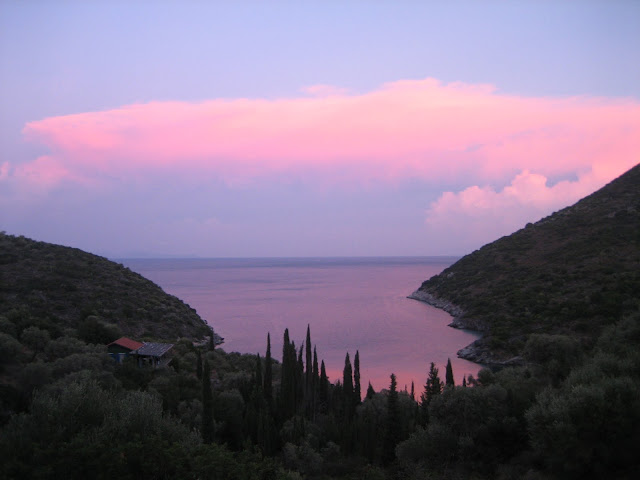
How's this for random nerdiness?
 I found this fishbowl in my grandfather's crawlspace. I gave it a good cleaning and now it stores my oddballs. I'm so tickled with this, it's ridiculous.
Great Book #16: Death Comes For The Archbishop
 This book--the physical book--is quite special to me. My grandmother was a voracious reader, but she owned very few books; the public library was her library. Death Comes For The Archbishop is one of the few books she kept a copy of (writing her name on the fly), and I distinctly remember her saying that Willa Cather was one of her favorite writers. I would have been too young to read her then, but I'm certainly appreciating her now. Willa Cather wrote my all-time favorite ghost story, and I've enjoyed Death Comes For The Archbishop almost as much.I imagine it is extremely difficult to write A (Good) Novel In Which Nothing In Particular Happens (the only other example I can think of is John McGahern's That They May Face the Rising Sun). A story without a plot (or an episodic plot as in this case) has to compensate in other ways, with memorable characters and an extraordinarily vivid sense of time and place.This novel follows the life, work, and travels of Father Jean Latour in 19th-century New Mexico. Death Comes For The Archbishop continually reminded me of Georgia O'Keeffe--but Cather paints the American Southwest with words, from the perilous mountains and ravines the priests must traverse to the eerie mesa towns perched high above the desert floor. Take this sublimely simple description of dusk:
They relapsed into the silence which was their usual form of intercourse. The Bishop sat drinking his coffee slowly out of the tin cup, keeping the pot near the embers. The sun had set now, the yellow rocks were turning grey, down in the pueblo the light of the cook fires made red patches of the glassless windows, and the smell of piñon smoke came softly through the still air. The whole western sky was the colour of golden ashes, with here and there a flush of red on the lip of a little cloud. High above the horizon the evening-star flickered like a lamp just lit, and close beside it was another star of constant light, much smaller.
And like her landscapes, Cather is brilliant at nailing a character in just a few words:
Don Manuel Chavez, the handsomest man of the company, very elegant in velvet and broadcloth, with delicately cut, disdainful features--one had only to see him cross the room, or to sit next him at dinner, to feel the electric quality under his cold reserve; the fierceness of some embitterment, the passion for danger.
The electric quality under his cold reserve. Gives me chills! Conversely, here's a splendid encapsulation of the Bishop's assistant, his dear old friend Father Vaillant: He added a glow to whatever kind of human society he was dropped down into.The other remarkable aspect of this novel is its abiding respect for Catholic missionaries. Desert life is a constant hardship, yet the Mexicans to whom Father Latour administers lead richly spiritual lives. They may have only the plainest, most serviceable clothes to wear to Mass, but they take great pleasure in arranging what little finery they have on their Madonna statues. Cather writes admiringly of their complete lack of materialism and the strength of their faith in the midst of unthinkable cruelty, so it's quite difficult to believe the author wasn't a devout Catholic herself (she was born a Baptist and later joined the Episcopal Church). My grandmother was a devout Catholic, but I'm sure that's only a small part of why she loved this novel.Here are a few more of my favorite lines (I'm not giving anything away--it is in the title, you know!):The old man smiled. "I shall not die of a cold, my son. I shall die of having lived."During those last few weeks of the Bishop's life he thought very little about death; it was the Past he was leaving. The future would take care of itself.Sometimes, when Magdalena or Bernard came in and asked him a question, it took him several seconds to bring himself back to the present. He could see they thought his mind was failing; but it was only extraordinarily active in some other part of the great picture of his life--some part of which they knew nothing. When the occasion warranted he could return to the present. But there was not much present left...only the minor characters of his life remained in present time.
Assateague Island
 At last, some new travel to report! This past weekend I went camping with my sister and several new friends on Assateague Island in Maryland, which is known (to everyone but me, apparently) for its population of wild ponies. It was overcast the whole time, but we still had fun getting our feet wet on the beach, walking through the marsh, and looking out for deer and horses.

 (That's Kate and Elliot having a seaweed fight. Some things will never change.)
Plum Truffle Redux
(Plum Truffle part 1, Plum Truffle part 2, Raveled here.)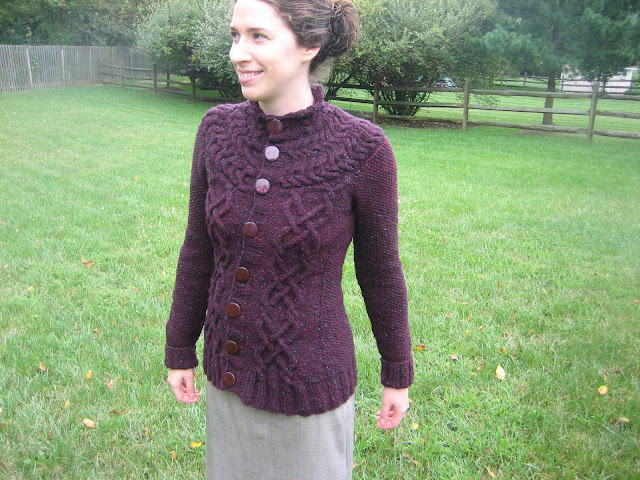 Well, those dimples on the button band were really annoying me, though I can't even wear it for another two months. I really liked the idea of an invisible button band, but on this cardigan it's just not working out. So I pulled out four lovely buttons I got from Jo-Ann ages ago, picked up four more (luckily they're still in stock), and now this button band is 100% visible.
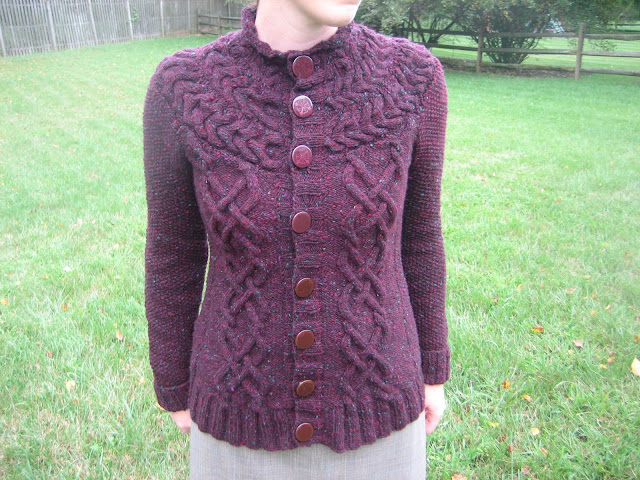 I had to reknit the buttonhole band because I'd originally knit it with dyelot #2, which would have been way too obvious to let show. Now the buttons are fastened on the 'wrong' side, but I certainly don't care enough to reknit both bands. Between the buttons and all the cabling, perhaps the effect is a bit busy--but still a big improvement, methinks!
1930s Tennis Blouse
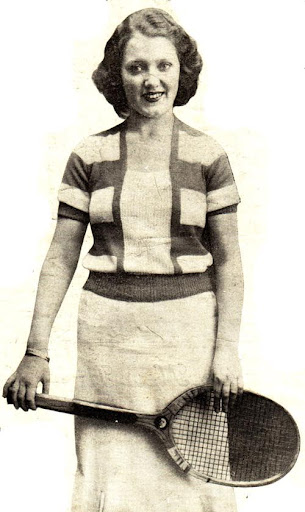 (Tennis blouse, part 1.)This one spent quite a few weeks in time-out before I finally dealt with all the little things that were annoying me about it. First, I have decided that I really do not like knitting with cotton. The fiber has no give, and my fingers actually started to feel a bit sore after awhile. Also, it may not have been such a good idea to stray so far from the original pattern. One word: STRIPES. Since I knit the front in pieces, they were a b***h to match up. Plus, the lace pattern slants to the right (oops), so it was tricky to seam so it laid evenly. I'm not pleased with my finishing on this one either, but it's time to call it a day. It's quite pretty...if you don't look too closely at it.
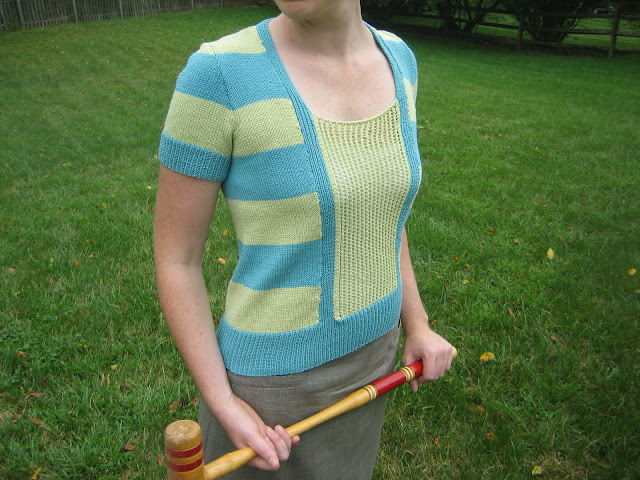
Pattern: 1930s Striped Sweater with Lace Panel, from Vintage KnittingYarn: Rowan 4-ply Cotton (discontinued) in aegean and fresh, 3 balls eachNeedles: #2s for the ribbing and #3s for the bodyRaveled here (with detailed pattern notes, not that I suggest you follow them!)
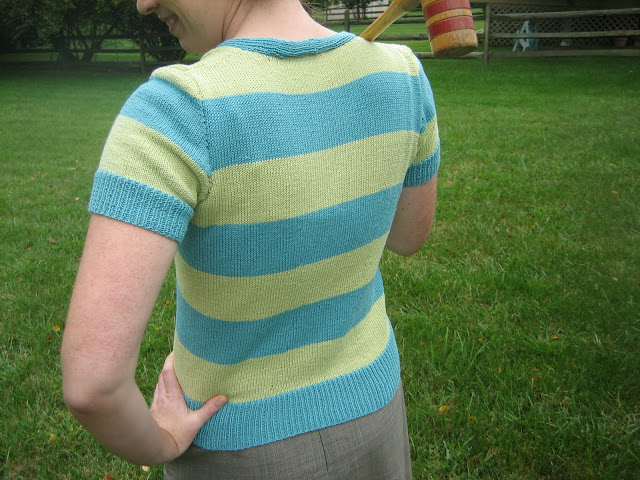 Kate took these pics today, a very gloomy Labor Day. No tennis racket to hand, but I found my grandparents' old croquet set in our garage. I think this qualifies as random nerdiness.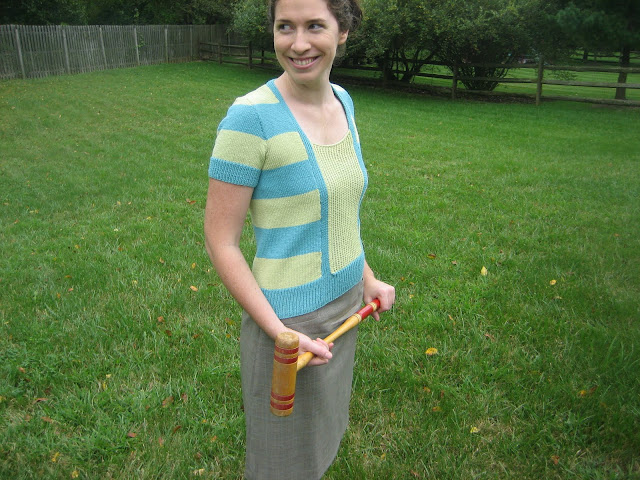
Poll Results
Eighteen readers! Oh, you dear sweet wonderful people! That's about three times the number I was expecting. Random nerdiness wins. Who would have thought?
Plum Truffle, finished at last!
I have WAY too many unfinished projects. Some I can only file away (like notes for stories I won't get around to writing for years yet), but others--the crafty stuff--I can certainly put to bed. So I've started a UFO ('unfinished object') smackdown. Remember this? I got midway through before I realized I wasn't going to have enough yarn, so I ordered another skein (to be delivered to NJ, though I was still in Galway at the time), and the project went into hibernation.
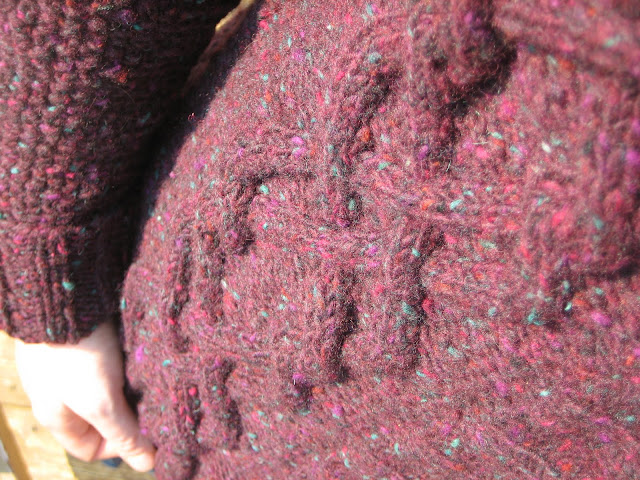 There was another problem: as I was knitting the body I had the nagging feeling that I had cast on too many stitches, and that if I proceeded as planned (even with plenty of back shaping) the body wouldn't be as form-fitting as I'd envisioned. So I thought maybe I could just make the button bands narrower, but eventually I got honest with myself--I wouldn't like how that would look. The button bands should be as wide as they are in Megan Rogers' original (or is that 'original knockoff'?) I very briefly contemplated frogging the whole body, but ouch! Rip out eleven inches of careful cabling? Not if I could possibly help it.It seems letting a troublesome project hibernate for awhile can make all the difference, because I took it out after a few months of inactivity, 'tried it on,' and thought of a MacGyver-ish solution: bind off several stitches on each side on the very next row, and steek that too-wide bottom portion. I had never steeked before, and of course I see why it scares some knitters stiff, but I used my trusty sewing machine and it all came out right...just in time for the frigid gales of August!
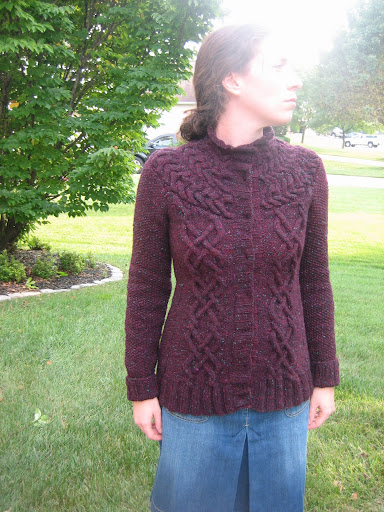 Pattern: Truffle Cardigan Tutorial in three parts, from Dulle GrietYarn: Rowan Yorkshire Tweed Aran (discontinued) in plum, 8 ballsNeedle: #7, and #6 for the button bands (binding off with a #9)Buttons: eight of 'em (1 1/8"), salvaged from my grandparents' candy tinRaveled here.
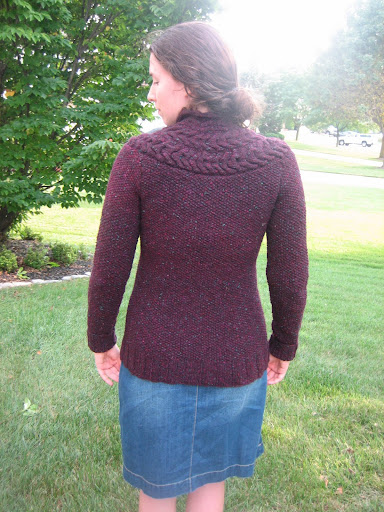 Apart from the slightly noticeable changes in dyelot (I tried to alternate balls, but apparently it didn't help much) and the dimples where the buttons are sewn to the button band (can it be helped? I'll re-sew them at some point), I'm so, so happy with this cardigan. I'm going to live in it this winter.
The Moon-Spinners
 I picked the perfect book for my weekend trip to Florida: The Moon-Spinners by Mary Stewart, which I discovered by way of Forgotten Classics (click the link to hear Julie read the first two chapters). Nicola, a 22-year-old English girl working at the British embassy in Athens, is on her way to the tiny Cretan village of Agios Georgios for a holiday with her cousin Frances when she gets mixed up in the aftermath of an attempted murder. Nicola is smart and capable, like all Stewart's heroines so I hear, and you have to wonder at how poorly her new friends Mark and Lambis would have fared without her intervention.I've never read a novel quite like this one--it's romantic suspense crossed with a vivid and beautifully written travelogue. The descriptive passages got me very nostalgic for my Greek adventure with Aravinda back in September 2006 (which I'll retro-blog next month...lots of gorgeous photos and funny stories to share!) This is not a romance novel though; the blossoming relationship between Nicola and Mark is all subtextual, which makes it all the more satisfying. But speaking of vivid descriptive passages, here's my favorite:
You might, in a simpler world, have said it was magic. There was the illuminated rock of the sea bed, every pebble clear, a living surface shifting with shadows as the ripples of the upper sea passed over it. Seaweeds, scarlet and green and cinnamon, moved and swayed in drowsy patterns so beautiful that they drugged the eye. A school of small fish, torpedo-shaped, and barred like zebras, hung motionless, then turned as one, and flashed out of sight. Another, rose-colored, and whiskered like a cat, came nosing out of a bed of grey coralline weed. There were shells everywhere.I lay and gazed, with the sun on my back, and the hot boards rocking gently under me. I had forgotten what I had come out for; this was all there was in the world; the sea, the sun hot on my skin, the taste of salt, and the south wind...
Go buy the book off Amazon marketplace for a penny. You'll be glad you did.
The Tenth Man
 Graham Greene's The Power and the Glory is #47 on my 100 Great Books list. I'm quite excited to read it now, because this week I came across a copy of The Tenth Man, a novella with an unusual history: Greene originally came up with the idea as a treatment for an MGM project before the war, and had the opportunity to novelize it many years later.A rich lawyer, Chavel, is imprisoned by the Nazis along with twenty-nine other Frenchmen. They're told that one in ten of them must die the next morning, so they draw lots. The rich lawyer is chosen, but offers his home and fortune to any man who will take his place. A sullen young clerk (who's probably dying of TB anyway), Michel Mangeot (called Janvier), takes Chavel up on his hysterical offer so that his mother and sister can live comfortably. Janvier is executed along with the other two men, and when Chavel is eventually released, he returns to the dead man's childhood home because he has nowhere else to go. Janvier's twin sister Thérèse offers him a job, and naturally he takes it. (Thérèse tells Chavel, who is now calling himself Charlot, that she will spit in Chavel's face if he ever returns. She's expecting him any day, so how can she not realize he's the very man she's confiding in? Even when she remarks on his familiar handwriting! But that's my only quibble.)The Tenth Man is the first Graham Greene I've read, and I love it--spare but incisive. I don't mind bleak stories so long as there's a point to the bleakness, and this story is beautifully so.
The darkness had long enclosed them both and now the last light slid off the ceiling of the cell. Men automatically turned to sleep. Pillows like children were shaken and slapped and embraced. Philosophers say that past, present, and future exist simultaneously, and certainly in this heavy darkness many pasts came to life: a lorry drove up the Boulevard Montparnasse, a girl held out her mouth to be kissed, and a town council elected a mayor; and in the minds of three men the future stood as inalterably as birth--fifty yards of cinder track and a brick wall chipped and pitted.
And look how he pegs Janvier's mother:
She was like an old weatherworn emblem of wisdom--something you find in desert places, like the Sphinx--and yet inside her was that enormous vacancy of ignorance which cast a doubt on all her wisdom.
This line impressed me as well, but for a different reason: When you reach a certain age you don't care about the future: it is success enough to be alive; every morning you wake with triumph. Greene may have come up with the original idea for The Tenth Man in the late '30s, but he was eighty years old by the time he was writing this novella.I'll leave you with one more gem:
She said, "You can't tell me he was unlucky. It's as you say. That thing happens to everyone once. All one's life one has to think: Today it may happen." It was obvious that she had brooded and brooded on this subject, and now at last she brought out the result aloud for anyone's hearing. "When it happens you know what you've been all your life."
Great Book #77: The Little Prince
 Back in high school one of my friends gave me a copy of Antoine de Saint-Exupéry's The Little Prince as a birthday present. I remember her giving it to me with a certain air of momentousness, as if the book had changed her life and she wanted that experience for me. I'm ashamed that it took me so long to read it, but now that I have, I see why she felt that way.The narrator is a pilot who has crashed in the Sahara and needs to fix his engine before his water supply runs out. A mysterious 'little man' with a head of golden curls appears out of nowhere, and asks him to draw a sheep. The little prince answers none of the narrator's questions about who he is or where he came from, but he always seems to know what the narrator is thinking, and the narrator eventually finds out that the little prince lives on an asteroid with three volcanoes (one extinct, but you never know) and only one flower, of which the prince is very fond. His planet is so small you can watch the sunset dozens of times a day just by going for a walk.In his interstellar travels the prince meets several adults, each on their own tiny planet, and each engaged in something completely pointless. I tend to think of myself as an overgrown child, but I'm certainly not immune to the grown-up absurdities the prince points out. But above all, The Little Prince is a fable about love, loneliness, and letting go. He meets a fox who begs to be tamed: "Wheat is of no use to me. The wheat fields have nothing to say to me. And that is sad. But you have hair that is the color of gold. Think how wonderful that will be when you have tamed me! The grain, which is also golden, will bring me back the thought of you. And I shall love to listen to the wind in the wheat..." Of course, the little prince must eventually part with the narrator, too--the scene is poignant but not overly sentimental.What's all too poignant is the fate of the author, which you can't help ruminating on as you look at his watercolors. Saint-Exupéry was a World War II pilot who was shot down during a reconnaissance mission in 1944, the year after The Little Prince was published.
He cried out, then:"What! You dropped down from the sky?""Yes," I answered, modestly."Oh! That is funny!"And the little prince broke into a lovely peal of laughter, which irritated me very much. I like my misfortunes to be taken seriously.
When I was a little boy, the lights of the Christmas tree, the music of the Midnight Mass, the tenderness of smiling faces, used to make up, so, the radiance of the gifts I received.
"And when your sorrow is comforted (time soothes all sorrows) you will be content that you have known me. You will always be my friend."
Great Book #40: Man's Search For Meaning
 Man's Search For Meaning by Viktor Frankl: I can't overstate how brilliant, how useful, how life-affirming it is. In a sentence, this slim book is about "saying yes to life in spite of everything"--the author was an innovative psychiatrist and neurologist from Vienna who survived Auschwitz and three other Nazi death camps. The first section describes his experiences in the concentration camps, and the second outlines Dr. Frankl's form of psychotherapy, logotherapy (from the Greek logos, "meaning"), in very practical terms. Dr. Frankl's psychiatric training made him uniquely equipped to observe his own behavior and those of his comrades in the death camps with a sort of 'cold curiosity.' He served as camp doctor, and had a chance to escape at one point, but decided not to abandon his typhus patients. He does not hold himself up as some example of 'the right way to suffer', however: "We who have come back, by the aid of many lucky chances or miracles--whatever one may choose to call them--we know: the best of us did not return."
Actual survival was, in a sense, irrelevant. To keep ever-present in his mind the faces of his loved ones (his wife in particular) and a vision of his future life, to retain his dignity and human impulses without denying the horrific reality of the concentration camp, marveling at a beautiful sunset even as his friends went 'up the chimneys'--he did all this, but without the intervention of blind chance at crucial moments he might not have survived. Dr. Frankl writes of emaciated prisoners exchanging recipes over hard physical labor, planning a post-war dinner party they knew full well would probably never happen. But that's beside the point. It's not about when you die, but how you've lived.
There are so many moving and insightful passages I want to share with you here, but I'd end up transcribing most of the book! So here are just a few of the parts I underlined:
"'Listen, Otto, if I don't get back home to my wife, and if you should see her again, then tell her that I talked of her daily, hourly. You remember. Secondly, I have loved her more than anyone. Thirdly, the short time I have been married to her outweighs everything, even all we have gone through here.' Otto, where are you now? Are you alive? What has happened to you since our last hour together? Did you find your wife again? And do you remember how I made you learn my will by heart--word for word--in spite of your childlike tears?"
"...Mental health is based on a certain degree of tension, the tension between what one has already achieved and what one still ought to accomplish, or the gap between what one is and what one should become."
"To be sure, a human being is a finite thing, and his freedom is restricted. It is not freedom from conditions, but it is freedom to take a stand toward the conditions."
"A statistical survey recently revealed that among my European students, 25 percent showed a more-or-less marked degree of existential vacuum. Among my American students it was not 25 but 60 percent." [And this was written in the 1950s!]
"...We watched and witnessed some of our comrades behave like swine while others behaved like saints. Man has both potentialities within himself; which one is actualized depends on decisions but not on conditions."
"...You may of course ask whether we really need to refer to 'saints.' Wouldn't it suffice just to refer to decent people? It is true that they form a minority. More than that, they always will remain a minority. And yet I see therein the very challenge to join the minority. For the world is in a bad state, but everything will become still worse unless each of us does his best."
This is one of the very best books I have ever read. Enough said, right?